
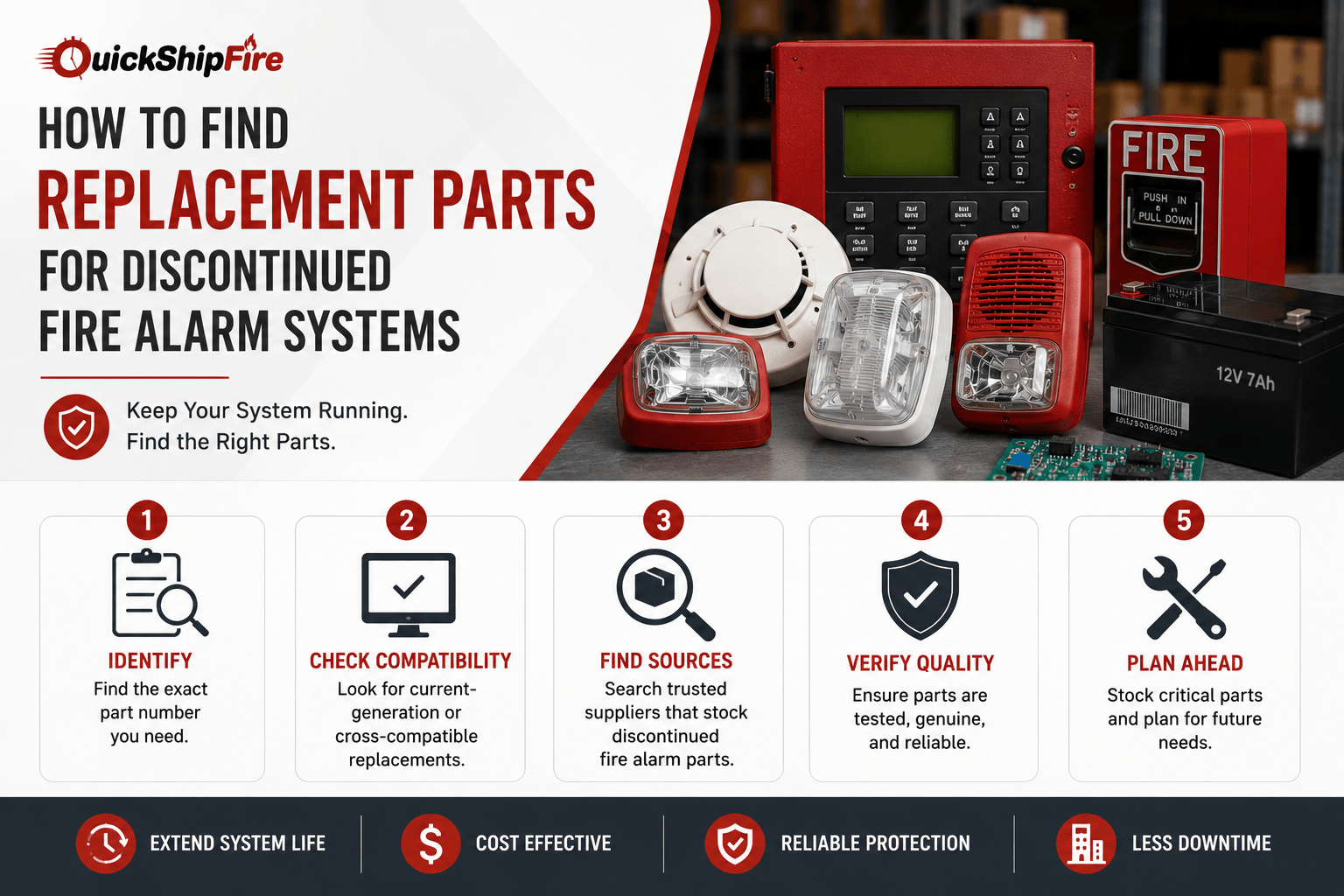
A building running on discontinued fire alarm systems equipment is not automatically a building that needs to be replaced. Manufacturers retire product lines for business reasons, product generation cycles, manufacturing consolidation, changing standards, long before every installed unit has actually failed, which leaves thousands of buildings running perfectly functional systems built on parts no longer sold through mainstream distribution. This guide covers how to identify exactly what you need, where to actually find parts for discontinued fire alarm systems, and how to decide when sourcing has become harder than the underlying system is worth.
How Common Are Discontinued Fire Alarm Systems, Really?
Discontinued fire alarm systems are far more common in the field than most building owners realize, simply because commercial fire alarm equipment is designed to last decades while the underlying product lines cycle every 10 to 20 years. A large share of the commercial buildings in service today are running at least some components from discontinued fire alarm systems, whether that means the main control panel itself, the detector line, or the notification appliances, even in buildings that otherwise appear completely modern. Recognizing this as a normal, manageable part of owning commercial property, rather than a crisis, is the right mindset for approaching a parts sourcing project.
Why Fire Alarm Systems Get Discontinued Long Before They Fail
Discontinued fire alarm systems usually start out as ordinary commercial fire alarm equipment built for a long service life, and a panel installed in the 1990s or early 2000s may still be performing reliably today, even though the detectors, modules, and components that were standard when it was installed have gone through two or three product generations since. Manufacturers eventually redirect service and manufacturing resources to current platforms, which is how discontinued fire alarm systems accumulate even while thousands of units remain in active service. This is especially common with legacy Simplex 4100, 4010, and 2001 series panels, older Siemens and Cerberus Pyrotronics equipment, and early-generation addressable panels from most major manufacturers, all of which now fall squarely into the category of discontinued fire alarm systems.
- Manufacturers discontinue product lines based on business and manufacturing cycles, not device failure rates.
- Discontinued fire alarm systems often remain fully functional for years or decades after parts leave mainstream distribution.
- Legacy Simplex, Siemens, and Cerberus Pyrotronics equipment are especially common candidates for parts sourcing challenges.
- A discontinued panel does not automatically mean discontinued detectors, modules, or notification appliances, and vice versa.
- Confirming exactly which components are actually unavailable, rather than assuming, is the first real step in any sourcing effort.
Step 1: Identify the Exact Part You Need
Before searching for parts for discontinued fire alarm systems, confirm the exact part number, not just the general device type. Fire alarm equipment often goes through minor revisions within the same model family, and a part number stamped on the back of an old detector base or printed on a circuit board silkscreen may include a revision letter or suffix that affects compatibility. Photograph the part, including any label text, before removing it, and check the system’s as-built documentation or a prior Record of Completion, since these documents often list exact model and part numbers that are no longer visible once a device is removed from the field.
- Confirm the exact part number, including any revision letter or suffix, before searching for a replacement.
- Photograph the part and its label before removal, in case the information is not legible once disconnected.
- Check as-built drawings and any prior Record of Completion for documented part numbers.
- Note the panel model and firmware revision, since compatibility often depends on more than just the part number alone.
- Determine whether the failed component is isolated or part of a broader pattern across similarly aged devices.
Step 2: Check for Compatible Current-Generation Replacements
In some cases, a part from a manufacturer’s current product line can replace a component from discontinued fire alarm systems with little or no modification, which is worth checking before assuming a part is truly unobtainable. Conventional, non-addressable detectors and heat sensors from the same manufacturer are frequently physically and electrically interchangeable across generations, since the underlying two-wire interface has changed less than addressable protocols have. Batteries are almost always cross-compatible by voltage and capacity specification rather than by brand; a current sealed lead-acid battery rated for the same voltage and amp-hour capacity as the original will work in the vast majority of older panels regardless of who originally supplied it.
Addressable components require more caution. Protocol compatibility between an older addressable loop and a newer device is not guaranteed even within the same manufacturer’s product family, so a current-generation fire alarm modules or detector should always be verified against the panel’s documented compatibility list before ordering, rather than assumed compatible simply because it carries the same brand name.
- Conventional detectors and heat sensors are frequently interchangeable across product generations within a brand.
- Batteries are typically cross-compatible by voltage and amp-hour rating rather than by original brand.
- Addressable devices require protocol compatibility verification, even within the same manufacturer’s current lineup.
- Check the panel manufacturer’s current published compatibility list rather than assuming based on the brand name alone.
- A current-generation part that requires a firmware update to the panel may not be practical on an otherwise unsupported system.
Step 3: Source Through Specialty Suppliers
When a part is genuinely unavailable through standard distribution, specialty suppliers that stock parts specifically for discontinued fire alarm systems are usually the fastest path to a solution. These suppliers maintain inventories of new-old-stock components, factory-reconditioned units, and tested used equipment pulled from decommissioned systems, none of which typically shows up through a standard manufacturer or big-box distributor search. A fire alarm control panel declared discontinued by its original manufacturer can often still be sourced as a Fire-Lite refurbished panels unit or an equivalent reconditioned model through exactly this kind of specialty channel.
| Sourcing Path | Typical Availability | Best For |
| OEM current distribution | Only current product generations | Panels and devices still in active production |
| Manufacturer reconditioned program | Limited, brand-specific | Select discontinued models with factory support |
| Specialty fire alarm parts suppliers | Broad; NOS and reconditioned stock | Genuinely discontinued panels, boards, and modules |
| Decommissioned system salvage | Inconsistent, project-dependent | Rare or highly specific legacy components |
| Full system upgrade | N/A; replaces the need for the part | When sourcing costs exceed the value of continued repair |
Step 4: Evaluate New-Old-Stock vs. Reconditioned Components
Specialty suppliers typically offer two categories of parts for discontinued fire alarm systems: new-old-stock, meaning genuinely unused inventory that was manufactured before the product line was discontinued but never installed, and reconditioned or refurbished units that have been tested, cleaned, and verified functional after being pulled from service or returned. New-old-stock components generally carry the same reliability expectations as when they were originally manufactured, since they were never actually placed into service. Reconditioned components can be an excellent option as well, provided the supplier tests and verifies functionality rather than simply reselling pulled parts as-is.
- New-old-stock (NOS) parts are genuinely unused inventory manufactured before discontinuation.
- Reconditioned parts should be tested and verified functional by the supplier, not simply resold as pulled.
- Ask suppliers directly about their testing and warranty policy for reconditioned or refurbished components.
- NOS fire alarm boards and power supplies are often the most impactful finds, since these components are expensive and disruptive to replace with a full upgrade.
- Keep a spare on hand once a hard-to-find part is located, since the same failure often recurs elsewhere in an aging system.
Step 5: Know When Sourcing Stops Making Sense
Sourcing parts for discontinued fire alarm systems is usually the more cost-effective path compared to full replacement, but it is not always the right call. If critical components, main boards, communicators, or power supplies, have become genuinely unavailable from any supplier, new or reconditioned, continued sourcing efforts become a losing proposition. A system that has failed multiple consecutive NFPA 72 inspections with panel-level deficiencies, rather than isolated device failures, is also signaling something a parts search will not fix. And a major renovation that already requires re-routing conduit throughout the building removes much of the cost advantage that made sourcing worthwhile in the first place.
- Critical components like main boards or communicators are unavailable from any supplier, new or reconditioned.
- The system has failed multiple consecutive inspections with panel-level, rather than isolated device-level, deficiencies.
- A planned major renovation already requires re-routing conduit throughout the affected areas.
- The cost of repeated sourcing and repair over 12-24 months approaches or exceeds the cost of a phased upgrade.
- The AHJ has issued a formal notice requiring modernization beyond what continued component sourcing can address.
Even when replacement eventually becomes the right decision, sourcing parts for discontinued fire alarm systems in the interim keeps a building compliant and protected while a properly planned upgrade is budgeted and scheduled, rather than forcing an unplanned, rushed replacement the moment one component fails.
QuickShipFire specializes in exactly this kind of sourcing for discontinued fire alarm systems, stocking new and Fire-Lite refurbished panels, boards, modules, addressable smoke detectors, and notification appliances for systems that other suppliers have stopped supporting. Request a quote with your part number, and our team will help you locate the exact component your discontinued system needs.
Conclusion
A discontinued fire alarm system is not the same thing as a failed one, and discontinued fire alarm systems in general are not automatically non-compliant systems, and in most cases the right response is targeted sourcing rather than immediate replacement. Identifying the exact part number, checking for compatible current-generation alternatives, and working with specialty suppliers who stock new-old-stock and reconditioned components can keep a legacy system compliant and reliable for years beyond what standard distribution channels would suggest is possible. Knowing when sourcing parts for discontinued fire alarm systems stops making financial sense, and a planned upgrade becomes the better investment, is the other half of managing an aging system responsibly.
Frequently Asked Questions
Where can I find parts for a discontinued fire alarm panel?
Start with the manufacturer’s reconditioned parts program if one exists, then check specialty fire alarm parts suppliers who stock new-old-stock and reconditioned components specifically for discontinued fire alarm systems, since these parts rarely appear through standard distribution channels.
Can a current-generation detector replace a discontinued one?
Sometimes, particularly for conventional, non-addressable detectors and heat sensors from the same manufacturer, which are often physically and electrically interchangeable across product generations. Addressable devices require more careful protocol compatibility verification before assuming a current part will work.
What is the difference between new-old-stock and reconditioned fire alarm parts?
New-old-stock parts are genuinely unused inventory manufactured before a product line was discontinued but never installed. Reconditioned parts have been in service before, then tested, cleaned, and verified functional by the supplier before resale.
Are batteries for discontinued fire alarm panels hard to find?
Usually not. Batteries are typically standardized by voltage and amp-hour capacity rather than by original brand, so a current sealed lead-acid battery matching the original specification will work in most older panels regardless of manufacturer.
How do I identify the exact replacement part I need for a discontinued fire alarm system?
Confirm the exact part number, including any revision letter, from the device label or system as-built documentation, note the panel model and firmware revision, and photograph the part before removal in case the label becomes illegible or is lost.
When should I stop sourcing parts and upgrade the whole system instead?
When critical components like main boards or communicators are unavailable from any supplier, when the system has failed multiple inspections with panel-level deficiencies, or when a planned renovation already requires re-routing conduit, continued sourcing typically stops making financial sense compared to a planned upgrade.
Is it legal to keep operating a discontinued fire alarm system?
Yes, as long as the system continues to pass its required NFPA 72 inspections and testing. A system is not automatically non-compliant just because the manufacturer has discontinued the product line; compliance is based on inspection results, not product lifecycle status.