

Effective warehouse fire safety is one of the most demanding challenges in commercial property protection, because the very features that make a warehouse efficient soaring ceilings, dense racking, and vast open floors are also the features that allow a fire to grow undetected. A small smouldering source buried among palletised goods can develop for several minutes before a ceiling-mounted detector ever registers it, and by then the fire may already be spreading through stored stock. Protecting these facilities is not simply a matter of installing more devices; it demands the right detection technology, correctly engineered for the space. Choosing dependable fire safety equipment is the first step, but understanding why large spaces behave so differently is what separates a merely compliant system from one that genuinely keeps people and property safe. This article breaks down the core detection challenges in warehouses and the proven solutions that address them.
Why Warehouse Fire Safety Demands a Different Approach
Warehouse fire safety cannot rely on the same assumptions that govern an office or a retail store. The scale of the environment changes the physics of how smoke and heat travel, while the contents of the building dramatically raise the stakes if a fire takes hold.
The Risk Profile of Large Storage Environments
Warehouses typically hold enormous fuel loads cardboard, paper, plastics, textiles, and packaging that ignite easily and burn fast. According to the National Fire Protection Association, multiple warehouse fires are reported across the United States every day, and the resulting property losses run into the hundreds of millions of dollars annually. High-rack storage creates vertical fire paths that let flames climb quickly, and the sheer volume of combustible material means even a modest ignition can escalate within minutes.
Scale, Height, and Occupancy
Unlike a busy office, a warehouse may be staffed by only a handful of people spread across tens of thousands of square feet. This low occupancy density means a developing fire is unlikely to be noticed by a person, placing the entire burden of early warning on the detection system. Combined with ceiling heights that often exceed ten metres, this is what makes automated, technology-led detection the foundation of any serious warehouse fire safety strategy.
The Core Detection Challenges in Large Spaces
The biggest obstacle to protecting a warehouse is that conventional point detectors were never designed for this scale, which is exactly what makes warehouse fire safety harder to achieve as a building grows. Reliable high-ceiling fire detection requires understanding the specific conditions that defeat standard equipment, and investing in purpose-built early detection systems becomes essential once those conditions are clear.
High Ceilings and Smoke Stratification
In tall buildings, smoke does not always rise cleanly to the ceiling. As hot smoke ascends it cools and can form a stable layer well below the roof line a phenomenon known as stratification. Ceiling-mounted detectors sit above this layer and may not sense the smoke until the fire has grown significantly. Effective fire detection for large spaces must account for this behaviour, which is why height-tolerant technologies are so important.
Dust, Humidity, and False Alarms
Warehouses are rarely clean-room environments. Airborne dust from packaging, constant forklift movement, and seasonal humidity swings can all interfere with sensitive detectors, either masking real smoke or triggering nuisance alarms. Frequent false alarms also erode confidence and can lead staff to ignore genuine warnings.
Racking, Mezzanines, and Blind Spots
Tall racking, mezzanine floors, and irregular storage layouts create shadowed zones where smoke can accumulate without ever reaching a detector. Without carefully planned device placement, these blind spots leave portions of the facility effectively unmonitored.
Key detection obstacles in warehouses:
- Excessive ceiling height delays smoke from reaching ceiling-mounted detectors.
- Smoke stratification traps smoke in cool layers below the roof line.
- Dust and humidity clog sensors and cause nuisance false alarms.
- Racking and mezzanine blind spots leave hidden areas unmonitored.
- Wide temperature swings between loading bays and storage zones affect sensor reliability.
Warehouse Fire Detection Systems That Solve These Challenges
Once the challenges are clear, the solutions follow logically, and they form the cornerstone of modern warehouse fire safety. The best warehouse fire detection systems combine several complementary technologies, each suited to a particular condition. The goal is layered coverage: no single device type protects an entire warehouse perfectly, so the strongest designs blend them. A well-chosen mix of fire detection systems gives facility managers both speed and reliability.
Optical Beam Detectors
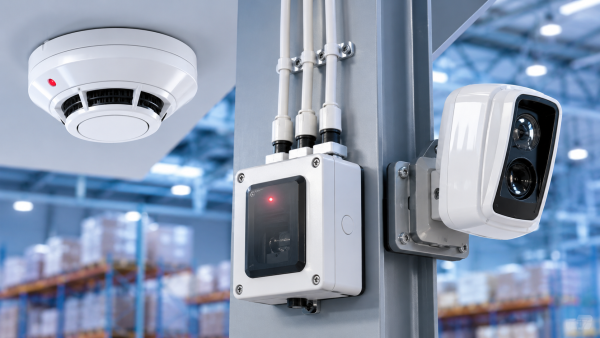
Optical beam detectors are purpose-built for wide, open areas with high ceilings. They project an infrared beam between a transmitter and a reflector across the width of the space; when smoke obstructs the beam, the system alarms. Modern auto-aligning models compensate for building movement, dust, and lighting changes, making them a cost-effective approach to high-ceiling fire detection across large open floors that point detectors cannot match.
Aspirating Smoke Detection (ASD) for Ultra-Early Warning
Aspirating smoke detection offers the earliest possible warning. An ASD system uses a network of small-bore pipes to continuously draw air samples from across the warehouse to a central, highly sensitive detection chamber. Because it actively samples the air rather than waiting for smoke to arrive, it can identify a smouldering fault before visible smoke even appears. For facilities storing high-value or highly flammable stock, VESDA aspirating detectors are often the gold standard, and ASD is widely recommended wherever downtime or product loss would be severe.
Recommended Reading: For a closer look at how ultra-early warning protects mission-critical facilities, see Data Center Fire Protection: Early Warning Detection Systems Explained.
Multi-Sensor and Flame Detectors
Multi-sensor detectors combine smoke, heat, and sometimes gas sensing in a single device, cross-referencing inputs to reduce false alarms while improving sensitivity to different fire types. Flame detectors add another layer, sensing the ultraviolet or infrared energy of an open flame. These respond rapidly in large or open areas where smoke takes time to accumulate, making them especially valuable where flammable liquids or fast-flaming materials are stored.
Where Point Smoke and Heat Detectors Still Fit
Conventional point detectors remain useful in the smaller, enclosed parts of a facility offices, break rooms, and loading docks where ceilings are lower and conditions are cleaner. The key is to deploy them where they perform well, not to cover the main storage hall.
Detection technology at a glance:
| Detection Technology | Best Suited For |
| Optical beam detectors | Wide, open, high-ceiling floor areas where point detectors cannot reach. |
| Aspirating detection (ASD) | Ultra-early warning and protection of high-value or highly flammable stock. |
| Multi-sensor & flame detectors | Mixed hazards, flammable liquids, and fast-flaming materials. |
| Point smoke & heat detectors | Smaller enclosed support areas such as offices and loading docks. |
Designing a Compliant Warehouse Fire Alarm System
Detection devices are only effective when they form part of a coherent, code-compliant whole, and that integration is central to dependable warehouse fire safety. A properly designed warehouse fire alarm system unites detection, notification, and control so that a single confirmed event produces a fast, coordinated response.
Codes and Standards, You Cannot Skip
In the United States, NFPA 72 governs the design, installation, and maintenance of fire alarm and signalling systems, and local fire codes add further requirements. A formal fire risk assessment determines the category of coverage a facility needs, dictating how many devices are required and where they must sit. Addressable systems, which identify the exact device that has triggered, are particularly valuable in large warehouses where pinpointing the location of an event quickly can save critical minutes.
Integrating Detection, Notification, and Control
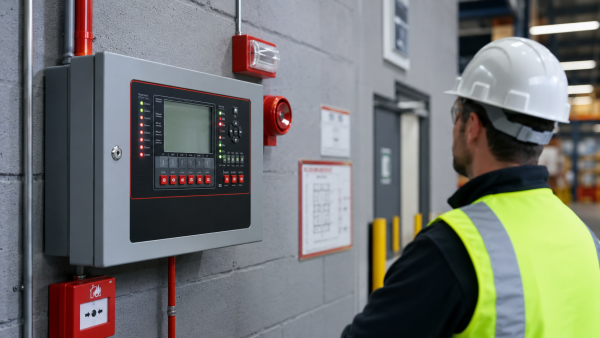
A complete alarm system ties detector into a central control panel alongside notification appliances and manual pull stations. Reliable fire alarm panels act as the brain of the installation, processing signals and triggering alarms, while modules and power supplies keep the network running. When these elements are engineered together rather than bolted on piecemeal, the result is a system that detects early and responds decisively.
Compliance essentials checklist:
- Complete a professional fire risk assessment before specifying any equipment.
- Select code-correct devices matched to ceiling height and the commodities stored.
- Use addressable zoning so triggered devices can be located instantly.
- Insist on documented commissioning and full functional testing at handover.
Maintaining Long-Term Warehouse Fire Safety
Installing the right system is only the beginning; lasting warehouse fire safety depends on keeping that system in peak condition year after year. Detection equipment that is neglected will gradually drift out of specification, and in a dusty, high-traffic environment that drift happens faster than many managers expect.
Inspection and Testing Schedules
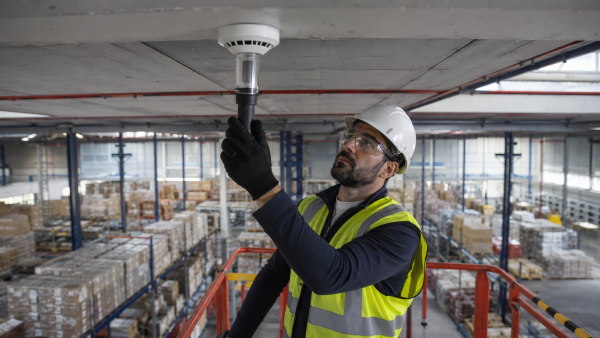
Routine functional testing, sensitivity checks, and visual inspections ensure every detector still performs as intended. Beam paths must be verified, aspirating pipework checked for blockages, and control panels tested for correct signalling. A disciplined schedule keeps the system reliable and supports compliance with insurer and code requirements, reinforcing overall warehouse fire safety.
Sourcing Reliable and Hard-to-Find Components
Fire alarm systems often remain in service for decades, and keeping a legacy installation compliant can hinge on finding a replacement board, module, or detector that the original manufacturer no longer produces. Sourcing brand-new, certified components even obsolete ones is essential to avoid compromising the system, and this is where a specialist supplier becomes invaluable, ensuring warehouse fire safety is never undermined by a single unavailable part.
Ongoing maintenance best practices:
- Follow a scheduled testing programme aligned with NFPA 72 and local codes.
- Perform regular dust cleaning of detectors and aspirating sampling points.
- Recalibrate sensitive detectors to prevent drift and false alarms.
- Replace components promptly with new, certified parts when faults appear.
Conclusion
Strong warehouse fire safety comes down to three principles: matching detection technology to the unique behaviour of large spaces, designing a fully code-compliant system, and maintaining that system diligently over its working life. High ceilings, dust, and dense racking will always make warehouses harder to protect than smaller buildings, but optical beam detectors, ASD, multi-sensor devices, and a well-integrated alarm system together turn that challenge into a solved problem.
At QuickShipFire, we have supported safety professionals and facility managers since 2017, backed by more than 20 years of Fire and Life Safety experience. We supply only brand-new equipment in its original manufacturer packaging, ship quickly across the U.S., and specialise in tracking down the hard-to-find and obsolete components that keep existing systems compliant. Whether you are protecting a brand-new distribution centre or upgrading an ageing installation, our team can help you specify the right solution. To discuss your project, request a quote and let us help you safeguard your facility with confidence.
Frequently Asked Questions
What is the biggest fire detection challenge in large warehouses?
The biggest challenge is smoke stratification combined with high ceilings. In tall buildings, smoke cools as it rises and can settle in a layer below the roof, so ceiling-mounted detectors may not sense a fire until it has already grown. This is why height-tolerant detection technology is essential for large warehouses.
What type of fire detection system is best for a warehouse?
There is no single best device. The most effective warehouse fire detection systems layer several technologies: optical beam detectors and ASD systems cover large open areas, while multi-sensor and point detectors protect smaller zones. Matching each technology to the conditions it suits delivers the most reliable coverage.
How does aspirating smoke detection (ASD) work in warehouses?
An ASD system draws air samples through a network of small-bore pipes to a central, highly sensitive detector. Because it actively samples the air rather than waiting for smoke to reach a device, it can detect a smouldering fire extremely early, often before any visible smoke appears.
Why do warehouse smoke detectors give false alarms?
False alarms are usually caused by airborne dust, humidity, forklift exhaust, or large temperature swings, all common in warehouse environments. Multi-sensor detectors, which cross-reference smoke, heat, and gas signals, significantly reduce these nuisance alarms while keeping sensitivity to genuine fires high.
What fire codes apply to warehouse fire alarm systems?
In the United States, NFPA 72 is the primary standard governing the design, installation, and maintenance of a warehouse fire alarm installation, supported by local fire codes. A professional fire risk assessment determines the required coverage category and dictates device quantity and placement.
How often should a warehouse fire detection system be inspected?
Most codes and insurers require regular functional testing, typically with detailed inspections at least annually and more frequent checks for critical systems. Dusty environments often warrant more frequent cleaning and sensitivity verification to keep detectors performing reliably and to maintain compliance.
Can beam detectors and point detectors be used together?
Yes. Layering beam detectors across open, high-ceiling areas with point detectors in enclosed offices and loading docks is a common and effective strategy. This combined approach delivers dependable fire detection for large spaces while ensuring smaller support areas are never overlooked.
Where can I buy reliable warehouse fire safety equipment and obsolete parts?
QuickShipFire supplies brand-new, certified warehouse fire safety equipment and specialises in locating hard-to-find and obsolete fire alarm components. With fast U.S. shipping and more than 20 years of industry expertise, it is a trusted source for both new installations and upgrades to existing systems.