
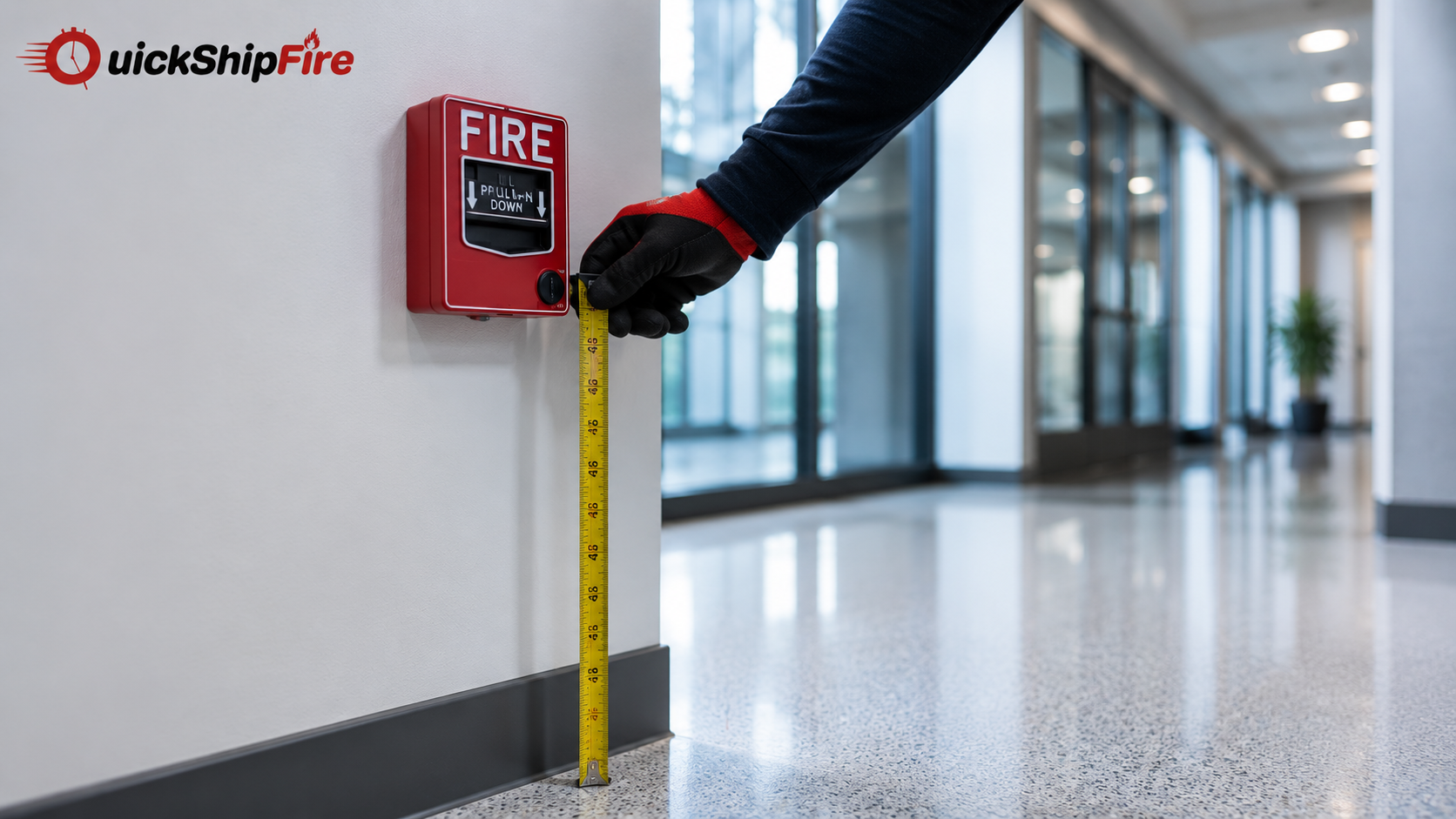
Correct pull station placement is one of the most overlooked yet heavily regulated parts of any fire alarm system design. A manual pull station only saves lives if occupants can reach it quickly, operate it easily, and find it where they expect it during an emergency. Getting pull station placement right means satisfying several overlapping rulebooks at once: The National Fire Alarm and Signalling Code, the ADA, and whatever local building codes your jurisdiction enforces. Whether you are designing a new system or upgrading an existing one with devices from our pull stations collection, this guide breaks down every placement rule that matters: mounting height, spacing, accessibility, and installation, so each device passes inspection the first time.
Why Pull Station Placement Matters in Fire Alarm Design
A fire alarm system is only as strong as its weakest link, and human activation is often the fastest way a fire gets reported. Smoke and heat detectors take time to sense a developing fire, but a person who spots flames can raise the alarm instantly if a station is within reach. That is why thoughtful device placement sits at the heart of life-safety design, not an afterthought bolted on at the end of a project.
The Role of Manual Pull Stations in Life Safety
Manual pull stations give occupants a deliberate, reliable way to initiate an evacuation. Mounted at exits and along corridors, they let anyone trigger the notification appliances, alert the monitoring service, and start the egress sequence with a single motion. Because they depend on people finding them under stress, predictable positioning matters enormously.
What Happens When Placement Goes Wrong
Poor placement carries real consequences. An inspector from the Authority Having Jurisdiction can fail the installation, forcing costly rework and delaying a certificate of occupancy. A station mounted too high, hidden behind a door, or too far from an exit can leave occupants unprotected and expose the owner to liability. Correcting these mistakes after drywall and finishes are in place is far more expensive than planning correct pull station placement from the start.
The Codes That Govern Pull Station Placement
Three layers of regulation shape where and how you mount each device. Understanding which document controls which detail keeps your design defensible when the inspector arrives.
NFPA 72 Pull Station Requirements
The National Fire Alarm and Signaling Code, NFPA 72, is the backbone standard for system design. The NFPA 72 pull station requirements cover where stations must be located, how far apart they can sit, the acceptable mounting height range, and the need for unobstructed access. For a deeper look at keeping a finished system compliant year after year, our fire alarm system maintenance checklist walks through the ongoing testing obligations that follow installation.
ADA and ICC A117.1 Accessibility Standards
The Americans with Disabilities Act and the closely aligned ICC A117.1 standard govern accessibility. Together they define reach ranges, clear floor space, and the maximum force needed to operate a device, so people with disabilities can activate an alarm as easily as anyone else.
How Local IFC and IBC Codes Fit In
The International Fire Code and International Building Code adopt, and sometimes amend, the national standards. Your local jurisdiction decides which editions apply, which means two buildings in different cities can face slightly different rules. Always confirm the adopted editions before you finalize pull station placement.
Which standard governs what:
- NFPA 72: device location, spacing, travel distance, and mounting-height range.
- ADA / ICC A117.1: reach range, clear floor space, and operating force.
- IFC / IBC: which editions are legally adopted and enforced in your area.
- The AHJ: final interpretation and approval in the field.
Manual Pull Station Height Requirements
Mounting height is where accessibility and code most often collide. The manual pull station height requirements come primarily from the ADA reach ranges, and they apply to the operable part of the device – the handle or lever the user actually pulls, not the box behind it.
The ADA Reach Range and the 48-Inch Rule
For an unobstructed forward or side approach, the ADA sets the maximum reach height at 48 inches above the finished floor and the minimum at 15 inches. In practice, designers mount the operable part at roughly 48 inches, which keeps it reachable from a seated position while staying comfortable for standing occupants. A single-action device such as the Simplex 4099-9001 addressable pull station is built to sit cleanly within this range.
Measuring to the Operable Part, Not the Box
A common mistake is measuring to the bottom or center of the backbox instead of the operable handle. Codes reference the operable part, so always verify the final pulled-lever height after the device and its trim are installed. The manual pull station height requirements are measured to that exact point.
Height compliance quick-check:
- Maximum height to the operable part: 48 inches above the finished floor.
- Minimum height to the operable part: 15 inches above the finished floor.
- Reference point: the handle or lever, never the backbox.
- Provide clear, unobstructed floor space directly in front of the device.
ADA Pull Station Requirements for Accessibility
Beyond height, the ADA pull station requirements address how a person physically reaches and operates the device. These rules ensure that occupants who use wheelchairs or have limited dexterity are never excluded from raising an alarm. Review accessible single-action options in our pull stations collection
Clear Floor Space and Approach
Each station needs an accessible approach with clear floor space generally a 30-by-48-inch area so a person using a mobility device can pull alongside or directly in front of it. Obstructions such as furniture, signage, or door swings must not encroach on that space.
Operating Force and One-Hand Operation
The device must be operable with one hand and must not require tight grasping, pinching, or twisting of the wrist. The activation force cannot exceed 5 pounds. Single-action stations satisfy this easily: one downward pull sets off the alarm. Meeting these ADA pull station requirements is non-negotiable in public and commercial facilities.
ADA compliance checklist:
- Operable part within the 15-to-48-inch reach range.
- Clear floor space of at least 30 by 48 inches at every device.
- Activation force of 5 pounds or less.
- One-hand operation with no grasping, pinching, or twisting.
Pull Station Placement and Spacing Under NFPA 72
With height and accessibility settled, the next question is location. NFPA 72 drives the spacing logic, and getting it right is central to compliant pull station placement throughout the building.
A Station at Every Exit
The code requires a manual pull station at each exit on every story. Occupants instinctively move toward exits during an emergency, so placing a device within 5 feet of each exit door puts it where people will already be heading.
Travel Distance and Spacing Limits
NFPA 72 caps the travel distance to the nearest station at 200 feet of horizontal travel. In large, open floor plans, that often means adding stations in the middle of a space, not only at the doors, so no occupant is ever more than 200 feet from one. This travel-distance rule, rather than a fixed number, is what really drives placement in big-footprint buildings.
Multi-Story Buildings and Special Occupancies
Every story needs its own coverage, typically with stations at stairwell entries. Special occupancies hospitals, schools, and hazardous areas may carry additional requirements layered on top of the baseline, so coordinate early with the AHJ on any unusual conditions.
Quick-reference placement summary:
| Placement Factor | Governing Standard | Typical Requirement |
| Mounting height | ADA / ICC A117.1 | Operable part 48 in max, 15 in min above finished floor |
| Location at exits | NFPA 72 | Within 5 ft (60 in) of each exit door, on every story |
| Travel distance | NFPA 72 | 200 ft maximum to the nearest station |
| Operating force | ADA | 5 lbf maximum, one-hand operation |
| Clear floor space | ADA | At least 30 in by 48 in clear approach |
| Final approval | Local AHJ | Locally adopted code editions plus field judgment |
These figures reflect commonly adopted code editions; always verify against the editions enforced in your jurisdiction, and specify compliant hardware from our pull stations collection.
Fire Alarm Pull Station Installation Best Practices
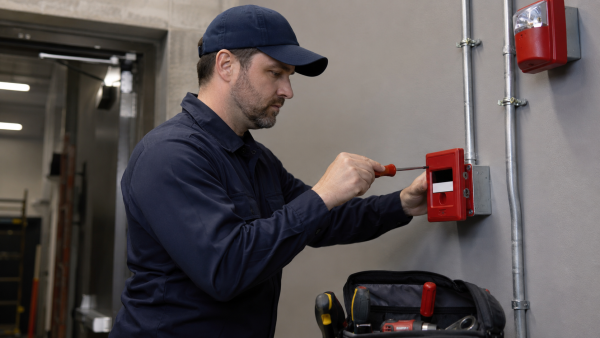
Sound design only pays off when the fire alarm pull station installation is executed cleanly in the field. Good installation practice protects both the equipment and the compliance you worked so hard to achieve on paper.
Planning, Wiring, and Device Selection
Choose devices that match your panel and circuit type addressable or conventional and confirm compatibility before ordering. Plan conduit and backbox locations during rough-in so finished heights land within code. If you are sourcing components for a fire alarm pull station installation and need help matching parts to an existing system, you can request a quote and our team will confirm compatibility before anything ships.
Common Placement Mistakes to Avoid
Watch for devices hidden behind open doors, mounted above the 48-inch limit, blocked by furniture, or placed beyond the 200-foot travel limit. Each is a frequent inspection failure, simple to avoid with one careful walk-through before final connections.
Installation do’s and don’ts:
- Do confirm the finished operable-part height before closing up walls.
- Do keep a clear, unobstructed approach at every device.
- Don’t mount stations behind door swings or large fixtures.
- Don’t exceed the 200-foot travel distance between stations.
Recommended Reading: If your facility includes sensitive or mission-critical spaces, see our guide on Data Center Fire Protection: Early Warning Detection Systems Explained to learn how automatic detection strategy complements manual pull-station activation.
Inspection, Testing, and Ongoing Compliance
Compliance does not end at installation. NFPA 72 requires periodic inspection and testing of every manual station to confirm it still activates and remains accessible. Renovations are a common culprit — a new partition or relocated furniture can suddenly block a once-compliant device. Re-verify pull station placement after any remodel, and keep documentation of every test for the AHJ.
Final Thoughts: Get Pull Station Placement Right the First Time
Correct pull station placement is a small part of a fire alarm system that carries outsized importance. When you align NFPA 72 spacing, ADA reach and force requirements, and your locally adopted code edition, you build a system that passes inspection and, far more importantly, protects every occupant. The key numbers a 48-inch height, a 5-pound force limit, a 200-foot travel distance, and a station at every exit are easy to honor when you plan them deliberately rather than fixing them later.
At QuickShipFire, we have spent more than twenty years helping safety professionals and facility managers get the right devices for compliant pull station placement. We stock brand-new, original-packaging pull stations from trusted manufacturers like Simplex, Notifier, and Fire-Lite, and we ship fast across the U.S. with real installation support behind every order. Browse our pull stations or request a quote today, and let us help you get your fire alarm system right the first time.
Frequently Asked Questions (FAQs)
What is the required mounting height for a manual pull station?
Under the ADA, the operable part of a manual pull station must be no higher than 48 inches above the finished floor for an unobstructed reach, and no lower than 15 inches. Most designers mount the handle at roughly 48 inches to satisfy both accessibility rules and everyday ease of use.
Where should fire alarm pull stations be located in a building?
Pull stations should sit along the natural path of egress, within 5 feet (60 inches) of each exit door, on every floor of the building. They belong at stairwell entrances and main exits, where occupants instinctively head during an evacuation.
What does NFPA 72 say about pull station placement?
NFPA 72 requires a manual pull station at each exit on every story, positioned so the travel distance to the nearest station never exceeds 200 feet. The code also addresses mounting height, accessibility, and the requirement that stations stay unobstructed and clearly visible.
Are fire alarm pull stations required to be ADA compliant?
Yes. In facilities covered by the ADA, manual pull stations must meet accessibility standards for reach range, clear floor space, and operating force. The device must be operable with one hand, without tight grasping, pinching, or twisting of the wrist.
How far apart should fire alarm pull stations be placed?
There is no fixed minimum distance between stations, but the maximum travel distance to reach any station cannot exceed 200 feet of horizontal travel, so extra stations are added in large open floor plans to keep every occupant within that limit.
How much force is allowed to operate an ADA-compliant pull station?
The force required to activate the station must not exceed 5 pounds. This keeps the device usable by people with limited hand strength or dexterity, so anyone can trigger the alarm in an emergency.
Can a pull station be installed on the outside of an exit door?
Pull stations are generally installed on the inside of the building, near the exit door and within 5 feet of it, so occupants activate them as they evacuate. Any exterior or special-application placement is determined by local codes and the Authority Having Jurisdiction.
Who has final authority over placement decisions?
The Authority Having Jurisdiction usually the local fire marshal or building official has the final say. Even when a design meets NFPA 72 and the ADA on paper, the AHJ can require adjustments based on locally adopted codes and real field conditions.