
Every modern detection system relies on a network of small but critical interface devices, and the addressable fire alarm module sits at the heart of that network. These compact units allow a control panel to communicate with, supervise, and command equipment that would otherwise be invisible to a digital system. Yet the two most common types monitor modules and control modules are frequently confused, even by experienced installers. Wiring the wrong device into a circuit can lead to failed inspections, supervision faults, and, in the worst case, a system that does not perform when it matters most.
This guide explains exactly what each device does, how they differ, and how to install them correctly. Whether you are a contractor planning a retrofit or a facility manager trying to understand your own building, knowing how each addressable fire alarm module functions will help you specify, install, and maintain a reliable life-safety system.
What Is an Addressable Module?
In an addressable system, every device on the loop carries a unique digital address. That address lets the panel identify precisely which device is reporting a condition, rather than simply naming a general zone. An addressable fire alarm module is an interface device that gives this digital identity to equipment that cannot speak the panel’s language on its own.
There was a time when all initiating devices were non-addressable, and a panel could only tell you that something somewhere in a zone had activated. Interface modules changed that. They act as translators, converting the simple on/off signal of conventional equipment into addressable data the panel can understand. The two workhorses of this category are the monitor module and the control module, and although they look similar, their jobs are opposite in direction. Choosing the correct addressable fire alarm module for each task is the foundation of a dependable installation.
Understanding the Monitor Module
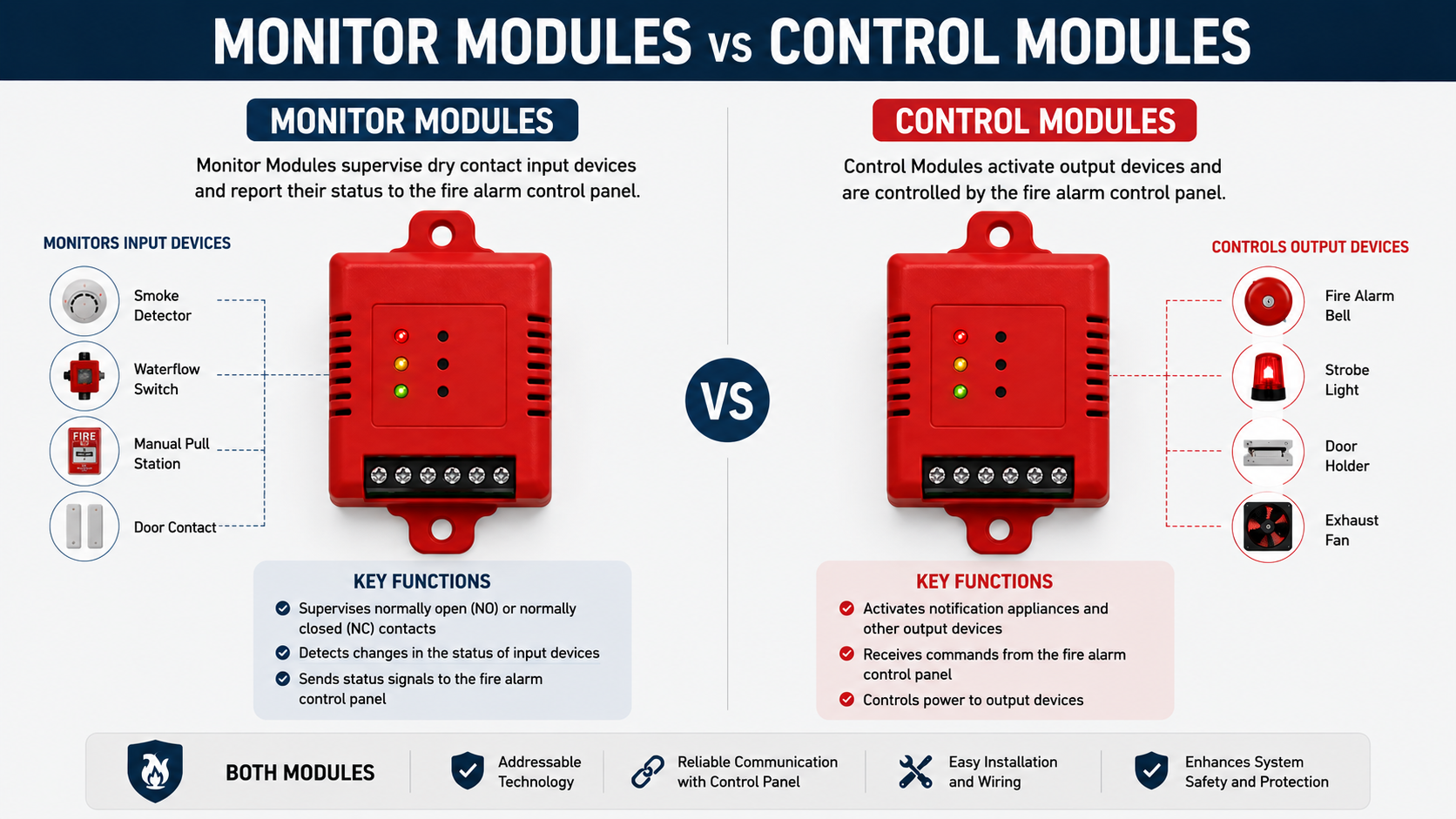
A fire alarm monitor module is an input device. Its job is to watch the status of a connected device or circuit and report that status back to the control panel. Think of it as the system’s eyes: it gathers information and sends it inward. When the addressable fire alarm module detects that the device it watches changes state from normal to alarm, trouble, or supervisory – the module relays that change to the panel along with its unique address.
Common Uses for Monitor Modules
- Connecting sprinkler waterflow switches so the panel knows water is moving through the system.
- Monitoring valve tamper switches that report when a critical sprinkler valve has been closed.
- Bringing conventional pull stations or loops of standard heat detectors onto an addressable loop.
- Watching the status of interfaced equipment such as suppression panels or other building safety systems.
An input device of this kind preserves the value of existing equipment. Rather than rip out and replace every conventional flow switch when a building upgrades, an installer can place an addressable fire alarm module on each one. The panel then gains individual device supervision and precise alarm reporting without a full rewire. This makes the monitor module one of the most budget-friendly tools in any retrofit project.
Need reliable interface devices for your project? Explore our full range of addressable fire alarm modules monitor, control, and relay devices from trusted manufacturers, all brand new and ready to ship fast across the United States.
Understanding the Control Module
A fire alarm control module is an output device. Where the monitor module reports inward, the control module carries commands outward from the panel to equipment in the field. When the panel decides an action is required, it activates the addressed module, which in turn switches the connected load. It is the system’s hands rather than its eyes.
Common Uses for Control Modules
Output modules are typically used to supervise wiring to load devices that need an external power supply, such as horns, strobes, and bells. In that role the device drives a notification appliance circuit, energizing audible and visible signals so occupants know to evacuate. Output modules are equally important for interfacing with third-party building systems: they can release magnetic door holders, recall elevators, shut down HVAC fans, close dampers, or activate suppression releasing equipment when the panel calls for it.
Because the control module performs an action, it is usually capable of both Class A and Class B supervision of its output wiring, ensuring the panel is alerted if the connection to the load is compromised. Addressability allows each addressable fire alarm module of this type to be activated selectively by zone or coverage area either automatically through panel programming or manually by an operator.
Monitor Module vs Control Module: Key Differences
The simplest way to remember the distinction is direction. A monitor module sends signals to the panel; a control module receives commands from the panel. The table below lays out the practical contrasts side by side.
| Characteristic | Monitor Module | Control Module |
| Function | Input device | Output device |
| Signal Direction | Field device to panel | Panel to field device |
| Typical Job | Reports alarm, trouble, supervisory | Activates horns, strobes, relays |
| Common Connections | Flow switches, tamper switches, pull stations | Notification appliances, dampers, elevators |
| Analogy | The system’s eyes | The system’s hands |
| External Power | Generally, not switched | Often switches an external supply |
Both devices are essential, and a typical building uses many of each. What matters is never mixing their roles. A monitor module should not be asked to drive a load, and a control module should not be used to watch a contact. Each addressable fire alarm module is listed and engineered for one direction of communication, and respecting that boundary keeps the system code-compliant.
Addressable Module Installation Best Practices
Correct installation is what turns a quality addressable fire alarm module into a reliable part of a life-safety system. The following practices apply to nearly every addressable fire alarm module on the market, regardless of manufacturer.
- Always read the manufacturer’s installation sheet. Wiring diagrams, addressing methods, and end-of-line resistor values vary between products, and the documentation is the authority.
- Set the address before mounting. Most modules are addressed with rotary switches or a programmer. Confirm and record the address so the panel database matches the field installation.
- Use the correct end-of-line device. Supervision depends on the proper resistor at the end of the monitored or controlled circuit. The wrong value defeats fault detection.
- Never combine systems on one module. Connecting fire, security, and supervisory devices to a single module jeopardizes the integrity of each system. Dedicate one module per function.
- Mount modules in accessible locations. Technicians must reach every device for testing and maintenance, so plan box locations with future service visits in mind.
- Verify compatibility with the panel. Each addressable fire alarm module is listed to work with specific control panels and communication protocols. Confirm the match before ordering.
After installation, every device must be tested as part of system acceptance. The panel should display the correct address and descriptor, and each monitored or controlled function must be confirmed to operate. Documenting these results protects the building owner and satisfies the authority having jurisdiction.
How Modules Connect to the Larger System
Interface modules do not work in isolation. They live on the signaling line circuit that runs from the fire alarm control panel out to every addressed device. The panel powers the loop, polls each device for its status, and stores a database that maps every address to a physical location and function. When a monitor module reports an alarm, the panel can pinpoint the exact device and, through programming, command the appropriate control module to respond.
This coordinated behavior is what makes an addressable system so powerful. A waterflow switch on the third floor can, within the same fire alarm control panel logic, trigger a notification appliance circuit on every floor, recall the elevators, and report the event to a central station all because each device carries a unique address. The interface devices are the bridge that makes this possible, which is why selecting quality, compatible products matters. Our article on modern fire alarm system integration explores how interface devices fit into a fully integrated design.
When you build out a loop, also consider the detection devices it will serve. Pairing the right interface modules with quality smoke detectors and other initiating equipment ensures the whole system speaks the same language and reports cleanly to the panel.
Planning an addressable upgrade or new installation? Our specialists can help you choose the exact modules your panel supports. Request a quote or get in touch with our team for fast, knowledgeable assistance.
Conclusion
Monitor modules and control modules may share a family resemblance, but they perform opposite and equally vital roles. A monitor module brings information into the panel; a control module carries commands back out. Understanding that distinction and following sound installation practices is the difference between a system that simply exists and one that performs flawlessly during an emergency. Every addressable fire alarm module you install should be correctly addressed, properly supervised, and matched to your control panel.
At QuickShipFire, we have spent more than twenty years helping contractors and facility managers find the exact interface devices their systems need, including hard-to-source and obsolete parts. Every addressable fire alarm module we ship is brand new in its original manufacturer packaging, backed by fast U.S. shipping and support that does not stop until your installation is complete. When your project depends on getting the right component quickly, we are ready to help.
Frequently Asked Questions
1. What is the main difference between a monitor module and a control module?
The difference is the direction of communication. A fire alarm monitor module is an input device that reports the status of a connected device back to the panel. A fire alarm control module is an output device that carries a command from the panel out to a load such as a horn, strobe, or relay. One watches; the other acts.
2. Can one addressable module do both monitoring and control?
Some manufacturers offer combination modules that include both input and output points in a single housing with one or more addresses. However, standard monitor and control modules are dedicated to a single direction. Always confirm a module’s listed function before assuming it can perform both roles.
3. Why can’t I connect fire and security devices to the same module?
Combining different systems on one module compromises the supervision and reliability of each. If a security device causes a fault, it can mask a fire condition, and vice versa. Best practice and most installation manuals require a dedicated module for each system and function.
4. Do addressable modules need to be supervised?
Yes. Supervision is a core requirement of any code-compliant system. Monitor modules supervise the wiring to the device they watch, and control modules supervise the wiring to the load they drive. The correct end-of-line device must be installed for supervision to function properly.
5. How do I know which module is compatible with my panel?
Each addressable fire alarm module is listed to work with specific control panels and communication protocols. Check the panel’s compatibility documentation or the module’s data sheet. If you are unsure, our team can confirm the correct device for your specific panel before you order.
6. Where should addressable modules be physically mounted?
Modules should be mounted in accessible electrical boxes, typically near the device or circuit they serve, so technicians can reach them for testing and maintenance. They should never be buried behind finished surfaces or in locations that require special access.
7. Can I reuse my conventional flow switches when upgrading to addressable?
In most cases, yes. A monitor module connected to each conventional flow switch gives it a unique address on the addressable loop, so you gain individual device identification without replacing the switch. This is one of the most cost-effective ways to modernize an older system.