
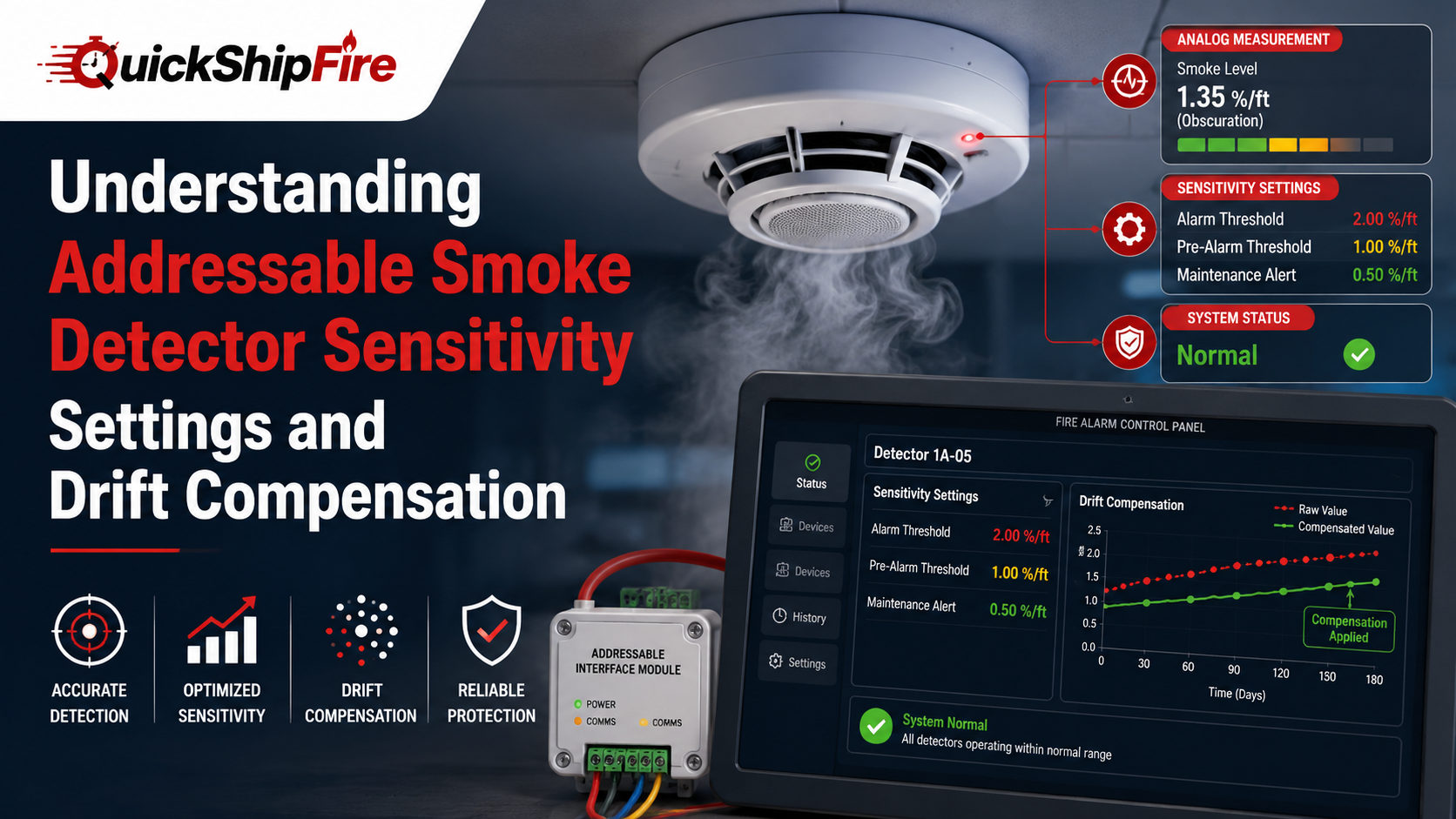
One of the most technically sophisticated and operationally consequential aspects of modern fire alarm systems is the management of addressable smoke detector sensitivity settings and drift compensation algorithms. Unlike their conventional counterparts, which operate on a simple fixed threshold, addressable analog detectors continuously measure and report the optical density of air passing through their sensing chambers and the fire alarm control panel uses that real-time data to make intelligent decisions about when to trigger alarms, issue maintenance alerts, and adjust for long-term sensor degradation. Understanding how this system works is not just an academic exercise: it is essential knowledge for fire safety professionals, facility managers, and building engineers who need to minimize false alarms without compromising detection reliability.
How Addressable Analog Smoke Detectors Measure and Report Obscuration
To understand sensitivity settings and drift compensation, it is first necessary to understand how an addressable analog smoke detector actually measures smoke. The core sensing technology in most addressable detectors whether photoelectric, ionization, or multi-criteria generates a continuous analog signal that represents the current optical density or ionization level inside the sensing chamber. This analog value is not simply an on/off alarm flag but a precise numerical reading that the detector reports to the fire alarm control panel at regular polling intervals.
Optical Obscuration and Percent-Per-Foot Measurement
In a photoelectric detector, an infrared LED transmits a beam of light through the sensing chamber. Smoke particles scatter this light toward a photosensitive receiver, generating a signal proportional to the concentration of particles in the chamber. This measurement is expressed in percent obscuration per foot (%/ft) a standardized unit that describes how much of the transmitted light is blocked over a one-foot path length. A reading of 0%/ft represents perfectly clean air; higher readings indicate increasing smoke concentration.
The addressable smoke detector sensitivity settings on most modern analog systems are configured in terms of this %/ft scale. A detector programmed with an alarm threshold of 2.0%/ft will generate an alarm signal when the measured obscuration in its chamber reaches that level. A detector with a threshold of 3.5%/ft will be less sensitive it requires a higher smoke concentration before triggering an alarm. Understanding and correctly setting these thresholds for each installation environment is one of the most important aspects of fire alarm system design and commissioning.
The Polling Architecture of Addressable Systems
In an addressable fire alarm system, the control panel continuously polls each detector on the signaling line circuit (SLC) at regular intervals typically once every few seconds. With each poll, the detector reports its current analog value, its status flags, and any maintenance conditions. The panel’s software evaluates the incoming analog value against the programmed alarm threshold, pre-alarm threshold, and maintenance alert thresholds for that specific detector address, and takes the appropriate action based on the results of that evaluation.
This real-time, device-level data stream is what fundamentally distinguishes the addressable smoke detector sensitivity management capability of modern addressable systems from the binary on/off behavior of conventional detectors. The panel is not simply waiting for a detector to close a contact it is continuously interpreting a stream of quantitative environmental data and making nuanced decisions based on that data, the programmed thresholds, and the cause-and-effect logic configured for the system.
Sensitivity Settings: Alarm Threshold, Pre-Alarm, and Maintenance Alert Levels
Modern addressable fire alarm systems support multiple sensitivity threshold levels for each detector, not just a single alarm point. Understanding what each threshold represents and how to configure it appropriately is central to effective addressable smoke detector sensitivity management.
The Alarm Threshold
The alarm threshold is the primary sensitivity setting the analog value at which the detector’s reading triggers a full fire alarm response at the panel. This is the setting most fire safety professionals are familiar with. Most addressable panels allow the alarm threshold to be configured individually for each detector address, typically within a range of approximately 0.5%/ft to 4.0%/ft depending on the manufacturer and detector model.
The analog smoke detector alarm threshold selected for a given detector location should reflect the specific environmental conditions, occupancy type, and fire risk profile of that space. In a clean server room where very early smoke detection is critical, a low threshold of 1.0%/ft or less may be appropriate. In a kitchen or a dusty industrial environment where background particulates are elevated, a higher threshold of 3.0%/ft or more may be necessary to prevent nuisance alarms while still providing adequate fire detection capability.
The Pre-Alarm Threshold
The pre-alarm threshold is set below the alarm threshold and triggers a supervisory or alert condition at the panel before a full alarm is generated. This two-stage detection architecture is particularly valuable in environments where a progressive investigation response is preferred such as hospitals, occupied high-rise buildings, or facilities where a false alarm would trigger a costly and disruptive evacuation.
When the detector’s analog value reaches the pre-alarm threshold, the panel can be programmed to alert staff, sound a local investigation tone, or notify security without activating the full alarm sequence. If the condition persists or escalates to the alarm threshold, the full response is then initiated. This staged approach is an important component of fire alarm false alarm prevention strategy and is one of the most effective tools available to reduce nuisance alarm rates in challenging environments.
The Maintenance Alert Threshold
The maintenance alert threshold is set above the alarm threshold and represents a level of sensor contamination that has not yet caused an alarm but indicates that the detector’s sensing chamber is dirty enough to require cleaning or replacement. When a detector’s ambient reading with no smoke present creeps up toward the maintenance threshold due to dust accumulation, the panel generates a maintenance alert identifying the specific device by address and location.
This proactive maintenance capability is one of the most operationally valuable features of addressable analog technology. Rather than discovering during an annual inspection that a detector has been operating outside its calibrated sensitivity range for months, facility managers receive a real-time alert at the panel the moment a detector needs attention. This directly supports an effective smoke detector maintenance and testing program and dramatically reduces the risk of a dirty detector generating either a false alarm or a failure to detect an actual fire.
Factors That Influence the Correct Sensitivity Setting for Each Location
Selecting the correct sensitivity setting for each detector location requires a careful evaluation of the specific environmental characteristics of that space. Here are the key factors that should drive your threshold configuration decisions:
- Occupancy type and life safety risk level: High-risk occupancies such as sleeping rooms, healthcare wards, and server rooms typically warrant lower (more sensitive) alarm thresholds to maximize early warning. Lower-risk storage areas or mechanical rooms may tolerate higher thresholds.
- Background particulate levels: Spaces with elevated airborne dust, steam, cooking aerosols, or exhaust particulates require higher alarm thresholds to avoid chronic nuisance alarms from non-fire sources. Industrial environments and commercial kitchens are prime examples.
- Ceiling height and airflow patterns: High ceilings and strong HVAC airflows can dilute smoke before it reaches the detector, which may argue for lower sensitivity thresholds to compensate for the dilution effect. Conversely, low-ceiling spaces with still air may develop higher local smoke concentrations very quickly.
- Detector spacing and coverage area: A detector covering a very large area at or near the maximum permitted spacing may need a more sensitive threshold to ensure detection of a remote fire source before smoke dissipates below the alarm threshold.
- Fire risk profile of the space: Spaces containing high-value assets, critical infrastructure, or flammable materials typically warrant more sensitive detection, even at the cost of a somewhat higher false alarm risk, because the consequences of a missed fire are catastrophic.
What Is Drift Compensation and Why Does It Matter?
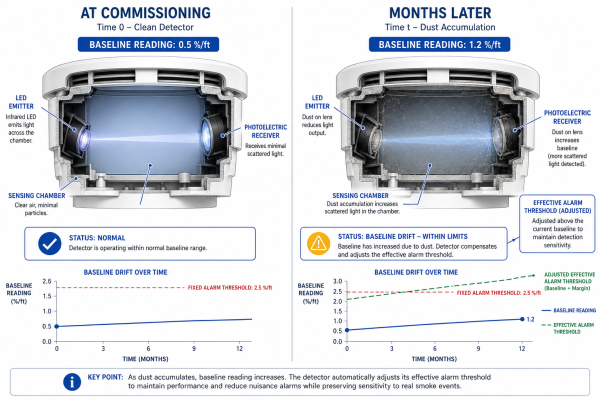
Even in clean environments with no deliberate smoke present, the analog readings of a photoelectric smoke detector will drift upward over time. This happens because microscopic dust particles, aerosols, insect debris, and other airborne contaminants inevitably accumulate on the optical surfaces inside the detector’s sensing chamber. As the chamber becomes progressively dirtier, the baseline optical scatter increases the detector appears to see progressively higher smoke levels even when the air is entirely clean. Left unmanaged, this drift will eventually cause the detector to generate a nuisance alarm based on contamination rather than actual smoke.
Smoke detector drift compensation is the automated mechanism built into modern addressable analog fire alarm systems to manage this inevitable baseline drift. The control panel or in some architectures the detector itself continuously monitors the detector’s clean-air baseline reading and periodically adjusts the effective alarm threshold to account for the gradual increase in that baseline. This prevents the contamination-driven creep from triggering false alarms while preserving the detector’s ability to respond to genuine fire-generated smoke.
How Drift Compensation Algorithms Work
The specific implementation of smoke detector drift compensation varies by manufacturer, but the general approach is consistent across the industry. The panel or detector firmware tracks the detector’s long-term average clean-air reading sometimes called the reference value or baseline and updates this reference at regular intervals, typically ranging from hours to days depending on the system configuration. The effective alarm threshold is then calculated as a fixed offset above the current reference value, rather than as a fixed absolute obscuration level.
For example, a detector might be configured with an alarm sensitivity of 2.0%/ft above baseline. If the detector’s clean-air baseline is initially 0.5%/ft (representing a small amount of inherent optical scatter from manufacturing tolerances), the effective alarm threshold is 2.5%/ft. As dust accumulates and the baseline drifts upward to 1.2%/ft over months of operation, the effective threshold automatically adjusts to 3.2%/ft maintaining the same sensitivity margin above the clean-air reference even as the absolute sensor reading has increased. This is the fundamental logic of drift compensation in addressable smoke detector sensitivity management.
The Limits of Drift Compensation
Drift compensation is a powerful tool, but it has important limits that facility managers and fire safety professionals must understand. Most addressable fire alarm systems implement an upper compensation limit a maximum baseline value above which the system will no longer continue to compensate and will instead generate a maintenance alert or trouble condition at the panel. This ceiling is typically defined by the manufacturer and is intended to ensure that the drift compensation mechanism does not inadvertently mask a detector that has become so contaminated that its sensitivity to actual smoke has been significantly degraded.
When a detector reaches the compensation ceiling, it is signaling that it can no longer be safely maintained in service through software adjustment alone it requires physical cleaning or replacement. Ignoring a maintenance alert that reflects a compensation ceiling event is a serious lapse in fire safety management. At QuickShipFire, we carry a comprehensive inventory of addressable smoke detectors from leading manufacturers, making it straightforward to source exact-match replacements when a detector reaches the end of its compensatable service life.
NFPA 72 Requirements for Smoke Detector Sensitivity
The management of addressable smoke detector sensitivity is not purely a matter of operational preference it is governed by specific requirements in NFPA 72: National Fire Alarm and Signaling Code. These requirements establish the permissible sensitivity range for smoke detectors, the testing intervals for sensitivity verification, and the documentation obligations that apply to all fire alarm system inspections.
The Permissible Sensitivity Range
NFPA 72 specifies that smoke detectors must be listed and operate within a sensitivity window of 0.5%/ft to 4.0%/ft obscuration, as established by UL 268 (Standard for Smoke Detectors for Fire Alarm Systems). The NFPA 72 detector sensitivity requirements further specify that detectors must be tested within one year of installation and at least every alternate year thereafter to verify that they are operating within their listed sensitivity range. If a detector is found to be operating outside this range either too sensitive or too insensitive it must be cleaned, recalibrated, or replaced before the system can be returned to a compliant state.
Sensitivity Testing Methods
Under the NFPA 72 detector sensitivity requirements, sensitivity testing for addressable analog detectors can be accomplished in several ways. For systems with addressable panels that continuously read and display the analog value of each detector, the panel’s own displayed reading when compared against the detector’s listed sensitivity range constitutes an acceptable sensitivity test, provided the panel and detector are both listed for this purpose. This is one of the most operationally significant advantages of addressable analog systems: sensitivity testing that would require specialized field instruments in a conventional detector installation can be accomplished directly from the fire alarm control panel.
For systems where the panel’s displayed analog value is not sufficient by itself to satisfy the sensitivity testing requirement, aerosol generators or calibrated test equipment may be used to expose the detector to a known smoke equivalent concentration and verify that it responds within the appropriate threshold range. The results of all sensitivity tests must be documented in the system inspection and testing records and maintained for at least three years as required by NFPA 72.
How to Read and Interpret Detector Analog Values at the Panel
The ability to read and correctly interpret detector analog values at the fire alarm control panel is a fundamental skill for anyone responsible for managing an addressable fire alarm system. Here is what you need to know about working with these readings effectively:
- Understand the scale your panel uses: Different manufacturers express analog values in different formats some display raw counts on a 0-255 scale, others display percent obscuration per foot (%/ft), and others use proprietary units. Consult the panel’s technical documentation to understand the scale before interpreting readings.
- Know each detector’s normal clean-air baseline: A detector reading that seems high in absolute terms may be entirely normal if the detector operates in a dusty environment. Compare current readings against the baseline established at commissioning, not against an absolute threshold, to assess whether drift is occurring at an abnormal rate.
- Use the panel’s maintenance alert display proactively: Rather than waiting for an alarm or a trouble condition, regularly review the panel’s maintenance alert list to identify detectors approaching their compensation ceiling. Proactive intervention prevents false alarms and avoids unplanned system downtime.
- Document baseline readings at commissioning: Record the initial clean-air analog value for every detector at the time of system commissioning. This baseline record is the most valuable reference point for evaluating whether a detector is drifting at an abnormal rate during subsequent inspections.
- Compare readings across similar detectors in similar environments: If one detector in a row of five identical units in the same corridor shows a significantly higher baseline than its neighbors, that outlier reading may indicate a localized contamination source, a detective sensing chamber, or a device approaching end of life.
The Role of the Photoelectric Smoke Detector in Sensitivity Management
The photoelectric smoke detector settings and drift compensation behavior are particularly important to understand because photoelectric technology dominates the addressable detector market for most commercial and institutional applications. Photoelectric detectors use light-scattering principles to detect the visible smoke particles characteristic of slow, smoldering fires the fire type most likely to develop in occupied commercial spaces where electrical faults, overheating materials, and smoldering upholstery are common ignition scenarios.
Why Photoelectric Detectors Are More Susceptible to Drift
The optical sensing principle that makes photoelectric detectors so effective at detecting visible smoke also makes them more susceptible to baseline drift from dust and particulate accumulation than ionization detectors. Because the sensor operates by measuring scattered light from particles in the chamber, any particle whether smoke-generated or dust-derived contributes to the measured signal. In environments with higher ambient dust levels, the rate of baseline drift is correspondingly higher, and the compensation mechanism must work harder to maintain stable sensitivity.
Understanding this characteristic is important context for interpreting addressable smoke detector sensitivity data from photoelectric units in different environments. A photoelectric detector installed in a dusty manufacturing facility will show a much faster baseline drift rate than an identical detector installed in a clean office space. The maintenance interval for the manufacturing environment detector should be correspondingly shorter to prevent it from reaching the compensation ceiling between scheduled inspections.
Multi-Criteria Detectors and Enhanced Sensitivity Management
Multi-criteria addressable detectors which combine photoelectric sensing with heat sensing, carbon monoxide sensing, or ionization sensing within a single unit offer enhanced sensitivity management capabilities relative to single-technology detectors. By evaluating multiple sensing inputs simultaneously, the detector’s onboard algorithm can more reliably distinguish between genuine fire conditions and environmental nuisance sources, reducing the rate of false alarm activations without requiring the alarm threshold to be raised to a level that compromises fire detection performance.
The photoelectric smoke detector settings on multi-criteria units typically allow independent threshold configuration for each sensing channel, giving fire safety engineers a high degree of control over the detection profile. In challenging environments where single-technology detectors struggle with nuisance alarms, multi-criteria units represent a powerful solution that addresses the problem at the detection algorithm level rather than requiring threshold increases that reduce sensitivity to genuine fire events.
Using Fire Alarm Panel Diagnostic Tools for Sensitivity Management
The fire alarm panel diagnostic tools built into modern addressable fire alarm control panels are among the most powerful resources available to facility managers and fire safety technicians for ongoing sensitivity management. Understanding how to use these tools effectively transforms sensitivity management from a reactive, inspection-driven process into a proactive, data-driven discipline.
Analog Value Displays and Historical Trending
Most modern addressable panels provide a real-time display of the current analog value for every detector on the system, accessible through the panel’s front-panel display or through a connected PC-based programming tool. Some advanced panels also store historical analog value trends for each detector, allowing a technician to plot the drift curve over weeks or months and identify detectors whose baseline is climbing at an unusually rapid rate before they approach the maintenance alert threshold.
This trending capability enables a genuinely proactive approach to addressable smoke detector sensitivity management. Rather than simply responding to maintenance alerts as they occur, a facility manager who regularly reviews analog value trends can identify outlier detectors early, investigate the cause of their accelerated drift, and schedule cleaning or replacement on a planned basis rather than on an emergency basis. This reduces operational disruption and supports a more efficient and cost-effective maintenance program.
Walk Test and Point-by-Point Diagnostic Modes
Addressable panels typically include a walk test mode that allows a technician to test each detector individually from the field without activating the full alarm sequence at the panel. In walk test mode, activating a detector by exposing it to aerosol or a magnet causes the panel to log the test event and confirm that the device communicated correctly without sending an alarm signal to the monitoring station or activating notification appliances throughout the building.
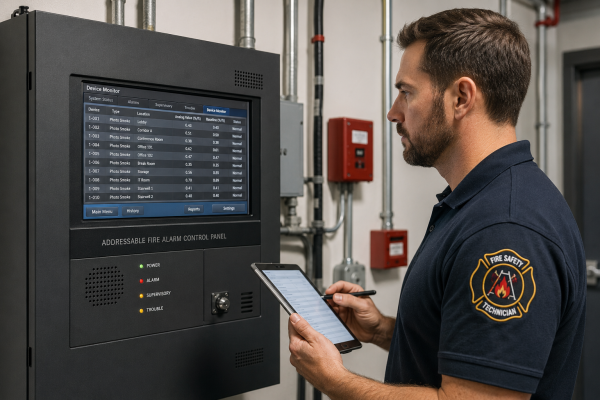
The fire alarm panel diagnostic tools also typically include point-by-point diagnostic screens that display the full status of each device current analog value, alarm threshold, compensation value, maintenance alert status, and communication health. These screens are invaluable during commissioning, annual inspections, and troubleshooting, providing a comprehensive picture of each detector’s operating condition without requiring a technician to physically access each device location.
Best Practices for Configuring Sensitivity Settings During System Commissioning
Getting sensitivity settings right at the time of commissioning is the single most important step in establishing a fire alarm system that reliably detects real fires while minimizing false alarms. Here are the best practices that experienced fire safety professionals follow during the commissioning process:
- Perform commissioning after the building is occupied and HVAC is running: Sensitivity settings established in an empty building during construction may be poorly calibrated for the actual environmental conditions that will exist when the space is occupied. Commissioning under operational conditions produces more accurate baseline readings.
- Record the initial analog value for every detector: Document the clean-air baseline reading for each device at commissioning as the reference point for all future maintenance evaluations. This record is required by NFPA 72 and is the most valuable tool for assessing long-term detector health.
- Set thresholds individually by zone and environment type: Avoid the temptation to use a single global sensitivity setting for all detectors in the building. Spaces with different environmental conditions require individually calibrated thresholds to achieve consistent detection performance without nuisance alarms.
- Configure pre-alarm thresholds for high-consequence zones: In areas where a false alarm would cause significant disruption operating theaters, data centers, occupied auditoriums configure a pre-alarm threshold that allows staff to investigate before the full alarm sequence is triggered.
- Document the cause-and-effect logic for each sensitivity tier: Ensure that the response programmed for pre-alarm, alarm, and maintenance alert conditions at each detector location is clearly documented and understood by the facility’s operations team so that each level of detector response triggers the appropriate action.
False Alarm Prevention Through Sensitivity Management
Chronic false alarms are one of the most damaging operational problems a fire alarm system can create they erode occupant trust in the system, create complacency that can prove fatal in an actual fire event, trigger fire department response fees, and in some jurisdictions lead to regulatory penalties. Effective fire alarm false alarm prevention through intelligent sensitivity management is therefore one of the highest-value activities a facility’s fire safety team can pursue.
Identifying the Root Cause of Recurring False Alarms
When a detector generates a false alarm, the addressable system’s diagnostic data is the first and most important resource for root cause investigation. The panel’s event log will show the detector’s analog value at the time of the alarm if that value was only marginally above the alarm threshold, the cause is most likely environmental contamination (drift) rather than an external smoke source. If the value spiked well above the threshold very rapidly, a transient environmental event a nearby aerosol spray, a momentary steam release, or a construction activity is more likely the culprit.
Understanding the mechanism of the false alarm guides the appropriate corrective response. A drift-related false alarm calls for detector cleaning or replacement and a review of the compensation rate. A transient environmental false alarm may call for a threshold adjustment, a pre-alarm configuration change, or an investigation into the environmental source that can be modified or eliminated. In both cases, the addressable smoke detector sensitivity data available from the panel is the essential starting point for analysis.
Alarm Verification and Its Relationship to Sensitivity
Alarm verification is a panel-level feature that introduces a deliberate time delay typically 10 to 60 seconds between the initial detection of a threshold crossing and the transmission of a full alarm signal. During the verification period, the panel monitors whether the detector’s reading remains above the threshold or returns to a normal level. If it returns to normal (indicating a transient event rather than a sustained fire), no alarm is transmitted. If it remains above the threshold, the alarm proceeds.
Alarm verification is a valuable analog smoke detector alarm threshold management tool in environments prone to transient nuisance events. However, it must be used judiciously NFPA 72 limits the maximum alarm verification delay for most occupancies and prohibits its use entirely in certain high-risk environments where the fastest possible alarm response is required. Always consult the applicable edition of NFPA 72 and your local AHJ before enabling alarm verification on a system.
Smoke Detector Cleaning, Replacement, and Sensitivity Restoration
When a detector’s drift compensation mechanism reaches its ceiling or when an inspection reveals that a detector is operating outside its listed sensitivity range, physical intervention is required. Understanding the options available cleaning versus replacement and the procedures involved is an important part of a complete addressable smoke detector sensitivity management program.
Cleaning Procedures and Limitations
Some addressable smoke detectors are designed to be field-cleaned by a qualified technician. The procedure typically involves removing the detector head from its base, carefully cleaning the sensing chamber and optical surfaces with compressed air or a soft brush, and reinstalling the detector before verifying that its analog reading has returned to the expected clean-air baseline. The smoke detector cleaning and replacement guidelines published by the detector’s manufacturer must always be followed improper cleaning can damage the optical surfaces or contaminate the chamber in a way that permanently impairs sensitivity.
It is important to note that cleaning restores a detector’s sensitivity only if the contamination is superficial. If the optical surfaces have been permanently stained or etched, if insects have damaged the sensing chamber, or if the detector has simply reached the end of its service life (typically ten years from the date of manufacture under NFPA 72), cleaning will not restore adequate sensitivity and replacement is the only appropriate response.
When Replacement Is the Right Choice
NFPA 72 recommends that smoke detectors be replaced after ten years from the date of manufacture, regardless of apparent condition. For addressable detectors operating in harsh environments high-dust areas, kitchens, industrial spaces a shorter replacement interval may be appropriate based on the rate of sensitivity drift observed in the system’s diagnostic data. The smoke detector cleaning and replacement decision should always be driven by the detector’s actual performance data, not by appearance alone a detector that looks clean externally may have significant internal contamination that only the analog value trend reveals.
QuickShipFire specializes in sourcing new-in-box replacement detectors for both current-production and legacy addressable fire alarm systems. Whether you need a standard replacement model or a hard-to-find device for an older system, our inventory includes smoke detectors and detector bases from leading manufacturers including Fire-Lite, Notifier, Simplex, System Sensor, and Silent Knight all brand new in original manufacturer packaging.
Need to source replacement addressable smoke detectors or compatible detector bases for your system? Browse QuickShipFire’s full smoke detector and detector base inventory all new in original manufacturer packaging, with fast U.S. shipping and expert technical support to ensure you get the right device for your specific control panel.
Building a Proactive Smoke Detector Sensitivity Maintenance Program
A reactive maintenance approach waiting for false alarms or trouble conditions before addressing detector sensitivity is the most expensive and operationally disruptive way to manage a fire alarm system. A proactive, data-driven program built around the diagnostic capabilities of your addressable system is far superior. Here are the essential elements of an effective program:
- Establish and document baseline analog values at commissioning: Record the clean-air reading for every detector at system commissioning. This is the foundation of all future comparative analysis and is required documentation under NFPA 72.
- Review analog value reports at each semi-annual inspection: Most addressable panels can generate a report of current analog values for all devices. Comparing these values against commissioning baselines at each inspection identifies detectors drifting at abnormal rates before they reach the alert threshold.
- Schedule cleaning or replacement proactively based on drift rate: If a detector’s baseline is climbing at two to three times the rate of its neighbors in a similar environment, it should be cleaned or investigated at the next scheduled visit rather than waiting for a maintenance alert.
- Maintain a replacement parts inventory for critical detector models: For large systems with many identical detector models, maintaining a small on-site stock of spare units allows rapid replacement of failed or contaminated detectors without waiting for procurement lead times.
- Track and trend false alarm events against detector analog data: Every false alarm event should be investigated using the panel’s event log and analog data. Correlating false alarms with detector sensitivity values reveals systemic problems such as a zone with consistently elevated drift that can be addressed through environmental improvements or threshold adjustments.
Sensitivity Settings Across Different Occupancy Types
The correct approach to addressable smoke detector sensitivity configuration varies significantly across different building types and occupancy classifications. A one-size-fits-all threshold setting is never the right answer here is how sensitivity strategy should be adapted for the most common occupancy types.
Office Buildings and Commercial Spaces
Standard office environments typically have relatively low background particulate levels and benefit from sensitivity settings in the mid-range approximately 1.5%/ft to 2.5%/ft for most zones. Kitchens and break rooms within office buildings require higher thresholds or specialty detection equipment to manage cooking aerosol nuisance events. Server rooms and network closets often warrant lower thresholds (1.0%/ft or below) given the catastrophic potential of an undetected equipment fire.
Industrial and Manufacturing Facilities
Industrial environments present the most challenging sensitivity management conditions, with elevated background dust, process fumes, steam, and temperature extremes all contributing to rapid detector drift and elevated nuisance alarm risk. Higher alarm thresholds, more frequent cleaning intervals, and in many cases specialty detection technologies such as aspirating smoke detection (ASD) systems or high-temperature-rated detectors are typically required. The smoke detector maintenance and testing program for industrial facilities should include quarterly analog value reviews and semi-annual cleaning of detectors in the highest-particulate zones.
Healthcare and High-Rise Residential
Healthcare facilities and high-rise residential buildings typically require the most carefully managed sensitivity settings because the consequences of both false alarms (patient disruption, evacuation risk for non-ambulatory occupants) and missed fire detection (life safety failure) are most severe. Staged detection with pre-alarm configurations, multi-criteria detectors in clinically sensitive areas, and alarm verification in appropriate zones are all important tools in these environments. Addressable panels serving these occupancies should be programmed to generate maintenance alerts at a conservative threshold to ensure maximum sensitivity is preserved throughout the detector’s service life.
Compatibility Between Detectors and Control Panels in Sensitivity Management
Effective addressable smoke detector sensitivity management depends on seamless communication between the detector and the control panel. Because addressable fire alarm systems use proprietary communication protocols, the sensitivity data that a detector reports and the way the panel interprets and acts on that data is determined by the specific protocol compatibility between the two devices. A detector from one manufacturer installed on a panel from a different manufacturer using an incompatible protocol will not report analog values, will not benefit from drift compensation management at the panel, and will not generate maintenance alerts even if both devices individually support these features.
When sourcing replacement detectors or expanding an existing addressable system, always verify protocol compatibility with the installed control panel before purchasing. QuickShipFire’s technical team is available to assist with compatibility verification across all major addressable protocols, and our inventory of fire alarm modules and communication devices includes interface solutions that can bridge compatibility gaps in certain hybrid or multi-manufacturer installations.
Not sure which replacement detectors or modules are compatible with your existing addressable fire alarm panel? Contact the QuickShipFire team for expert compatibility guidance our specialists have deep knowledge of all major addressable protocols and can help you identify the right devices for your system quickly and confidently.
Common Sensitivity Management Mistakes and How to Avoid Them
Even experienced fire safety professionals can fall into these frequently observed sensitivity management traps. Knowing them in advance is the best way to avoid costly errors:
- Raising thresholds to suppress false alarms without investigating the root cause: Increasing a detector’s alarm threshold to stop a recurring false alarm treats the symptom rather than the cause. If contamination or an environmental source is driving the false alarm, the threshold increase will reduce sensitivity to genuine fire without eliminating the underlying problem.
- Disabling drift compensation or maintenance alerts: Some panel configurations allow compensation or alert features to be disabled. Doing so to avoid the administrative burden of responding to maintenance alerts creates a dangerous situation where detectors can drift to insensitive states without any warning.
- Using non-compatible replacement detectors: Installing a detector with an incompatible communication protocol eliminates the addressable sensitivity management capabilities that justify the addressable system’s higher cost. Always verify protocol compatibility before installation.
- Skipping baseline documentation at commissioning: Without commissioning baseline analog values on record, there is no reference point for evaluating whether future readings represent normal drift or abnormal deterioration. This documentation gap makes meaningful trending analysis impossible.
- Ignoring accelerated drift in isolated detectors: A single detector showing a much faster drift rate than its neighbors in the same environment is signaling a problem either a localized contamination source, a manufacturing defect, or damage to the sensing chamber. This outlier should be investigated, not simply cleaned and restarted without analysis.
Conclusion
Managing addressable smoke detector sensitivity settings and drift compensation is one of the most technically sophisticated aspects of modern fire alarm system operation and one of the most operationally important. When done well, it produces fire alarm systems that detect real fires quickly, generate minimal false alarms, and maintain their sensitivity reliably across years of service. When done poorly, the consequences range from the chronic operational disruption of false alarms to the catastrophic failure of a life safety system to detect a genuine fire event.
The keys to effective sensitivity management are understanding the fundamental technology how analog detectors measure and report obscuration, how drift compensation algorithms work, and what the various threshold levels mean and then applying that understanding through a proactive, data-driven maintenance program built around the diagnostic capabilities of your addressable fire alarm control panel. NFPA 72 provides the regulatory framework, but the operational excellence comes from a disciplined, informed approach to the data your system is already generating every second of every day.
QuickShipFire is proud to support fire safety professionals, facility managers, and building engineers across the United States with high-quality addressable smoke detectors, detector bases, control modules, and fire alarm panels from leading manufacturers. Whether you are commissioning a new system, replacing aging detectors, or tracking down hard-to-find components for a legacy addressable installation, our team and our inventory are here to help you keep your fire alarm system performing at its best.
Frequently Asked Questions (FAQs)
1. What is addressable smoke detector sensitivity and how is it measured?
Addressable smoke detector sensitivity refers to the threshold level of smoke concentration expressed in percent obscuration per foot (%/ft) at which an analog addressable detector triggers an alarm signal at the fire alarm control panel. Unlike conventional detectors, which have a fixed factory-set threshold, addressable analog detectors continuously report their current sensing chamber reading to the panel, which compares that reading against the programmed alarm threshold to make alarm decisions. The sensitivity can typically be configured individually for each detector address through the panel’s programming software.
2. What is drift compensation in a smoke detector and why is it necessary?
Drift compensation is an automated mechanism in addressable fire alarm systems that adjusts the effective alarm threshold of a smoke detector to account for the gradual increase in its clean-air baseline reading caused by dust and particulate accumulation in the sensing chamber. Without drift compensation, every smoke detector would eventually generate a false alarm as its contaminated chamber produced readings above the fixed alarm threshold even in clean air. Drift compensation maintains a constant sensitivity margin above the current baseline, preventing contamination-driven false alarms while preserving genuine fire detection capability.
3. How often should addressable smoke detector sensitivity be tested under NFPA 72?
NFPA 72 requires that smoke detector sensitivity be tested within one year of installation and at least every alternate year (every two years) thereafter. For addressable analog systems, the panel’s displayed analog value when compared against the detector’s listed sensitivity range is generally accepted as a valid sensitivity test method, provided the panel and detector are listed for this purpose. All sensitivity test results must be documented in the system inspection and testing records and maintained for at least three years.
4. What does it mean when a smoke detector generates a maintenance alert at the panel?
A maintenance alert from an addressable smoke detector indicates that the detector’s baseline clean-air reading has risen to a level that requires attention either because the sensing chamber has accumulated enough contamination to approach the maintenance threshold, or because the detector’s drift compensation mechanism has reached its upper limit and can no longer compensate for further baseline increase. A maintenance alert is a proactive warning that the detector needs to be cleaned or replaced before it generates a false alarm or loses adequate sensitivity to genuine fire events. It should never be ignored or suppressed without investigation.
5. Can I use any addressable smoke detector as a replacement in my existing system?
No. Addressable smoke detectors communicate with the fire alarm control panel using proprietary digital protocols, and these protocols are not universally compatible across manufacturers. Installing a detector with an incompatible protocol on an existing system will result in communication failures, loss of analog value reporting, and loss of drift compensation and maintenance alert functionality even if the detector physically fits on the existing base. Always verify protocol compatibility between the replacement detector and your specific control panel model before purchasing. QuickShipFire’s technical team can assist with compatibility verification across all major addressable protocols.
6. What is the difference between the alarm threshold and the pre-alarm threshold in an addressable system?
The alarm threshold is the primary sensitivity setting at which a detector’s reading triggers a full fire alarm response activating notification appliances, transmitting an alarm signal to the monitoring station, and executing all cause-and-effect actions programmed for that zone. The pre-alarm threshold is set below the alarm threshold and triggers a supervisory or alert condition, typically used to notify staff for investigation before a full alarm is initiated. This two-stage detection approach is particularly valuable in high-consequence occupancies where a false full alarm would cause significant disruption, as it provides an opportunity to verify the alarm condition before the full response sequence is initiated.
7. How do I know when a smoke detector should be cleaned versus replaced?
The decision between cleaning and replacing a smoke detector should be based on its actual performance data rather than appearance alone. If the detector’s drift compensation mechanism has reached its ceiling and cleaning restores the baseline reading to a normal level, cleaning may be sufficient. If the baseline does not return to the expected range after cleaning, if the detector has been in service for ten or more years (the NFPA 72 recommended replacement interval), if the sensing chamber shows physical damage or insect intrusion, or if the drift rate returns to an elevated level shortly after cleaning, replacement is the appropriate course of action. QuickShipFire carries new replacement detectors for both current and legacy addressable systems to support rapid, compliant device replacement.