
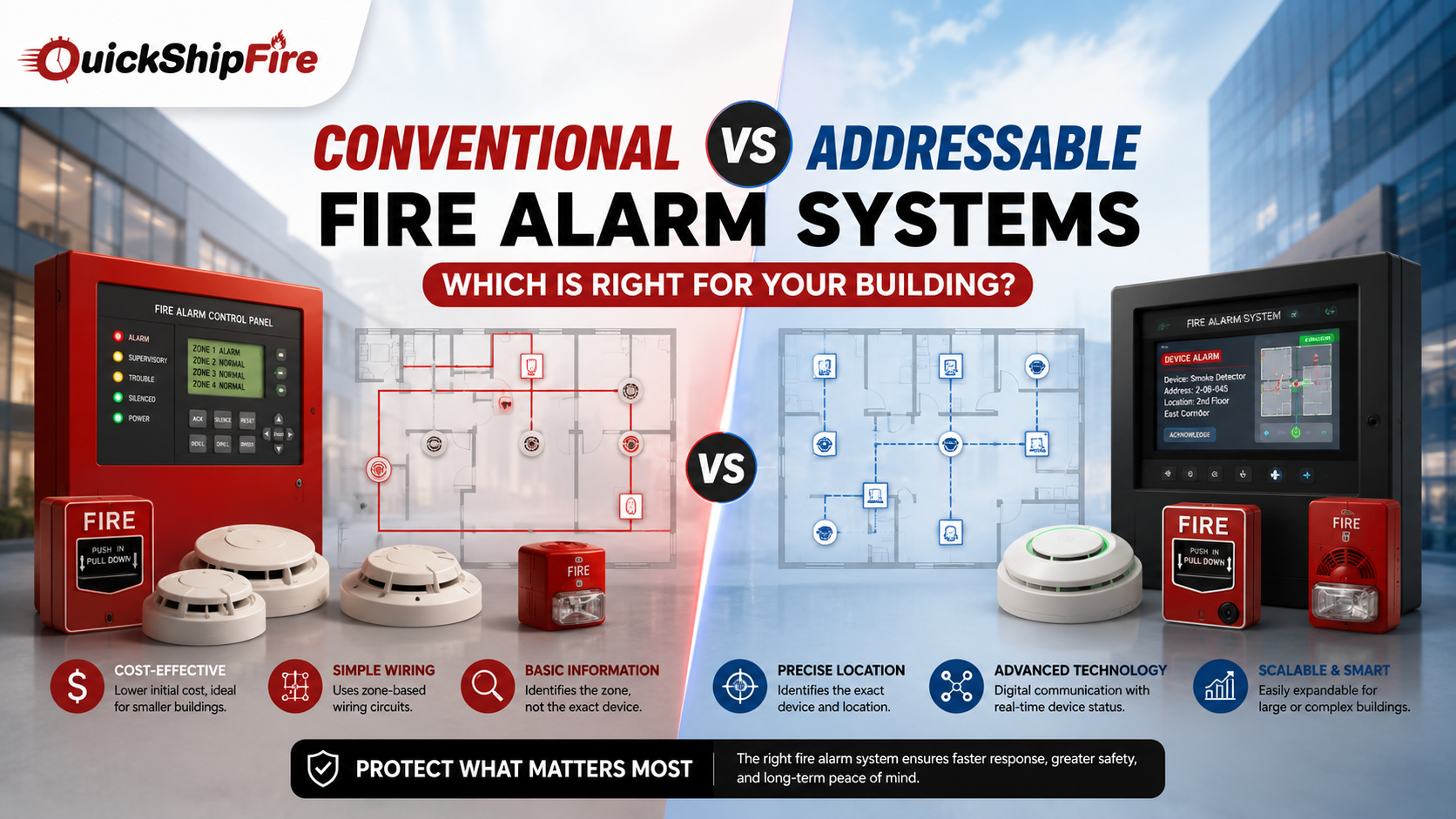
Choosing between conventional vs addressable fire alarm systems is one of the most consequential decisions a building owner, facility manager, or fire safety professional will make when designing or upgrading a fire protection infrastructure. Both system types are widely used across the United States, both comply with applicable fire codes when properly installed, and both can be built from high-quality components yet they differ fundamentally in how they detect, locate, and report fire events. Understanding those differences in depth is the key to making the right choice for your specific building, budget, and operational requirements.
In this comprehensive guide, we break down every meaningful dimension of the conventional vs addressable fire alarm systems debate from system architecture and wiring topology to cost, scalability, maintenance demands, and code compliance. Whether you are equipping a small retail space, a mid-rise office building, a sprawling industrial campus, or a multi-building institutional campus, this article will give you the knowledge you need to make a confident, well-informed decision.
Understanding the Fundamental Architecture of Each System
Before diving into the comparison, it is important to understand what actually distinguishes these two system types at a technical level. The core difference between conventional vs addressable fire alarm systems comes down to how individual devices communicate with the fire alarm control panel, and how precisely a triggered alarm can be located within the building.
How Conventional Fire Alarm Systems Work
A conventional fire alarm system divides a building into a series of zones, with each zone served by its own dedicated wiring circuit. All of the detectors and pull stations within a given zone are wired in parallel on that circuit, and they report to the fire alarm control panel as a group. When any device on a zone circuit is triggered, the panel illuminates a zone indicator but it cannot identify which specific device activated. The response team must physically search the entire zone to locate the source of the alarm.
This zone-based approach was the dominant fire alarm architecture for decades and remains a cost-effective solution for smaller, simpler buildings where a zone might encompass only a handful of rooms. In a single-story retail store with three zones, for example, a zone-level alert is sufficient to direct staff to the right part of the building within seconds. The conventional fire alarm zone wiring approach uses straightforward two-wire or four-wire circuits that are easy to install, test, and troubleshoot, making it a practical solution where pinpoint location is less critical.
How Addressable Fire Alarm Systems Work
An addressable fire alarm system assigns a unique digital address to every single device on the network each smoke detector, heat detector, pull station, and notification appliance has its own identity. Rather than simple on/off zone circuits, devices communicate with the control panel over a two-wire signaling line circuit (SLC) using digital data packets. When any device activates, the panel receives not just an alarm signal but the specific address and identity of that device, displayed immediately on the panel interface.
This device-level identification is the defining advantage of the addressable system architecture. In a ten-story office building with 300 devices, an addressable panel can immediately direct responders to “Smoke Detector 247 Floor 8 East Corridor” rather than “Zone 3.” The addressable smoke detector at the heart of this system can also communicate status conditions beyond simple alarm it can report dirty sensor readings, maintenance alerts, and pre-alarm conditions that allow for proactive intervention before a false alarm or an actual fire event fully develops.
Wiring and Installation Differences
The wiring architecture is one of the most visible and practically significant differences in the conventional vs addressable fire alarm systems comparison, affecting both the initial installation complexity and the long-term maintenance burden.
Conventional Wiring: Simple Circuits, Limited Feedback
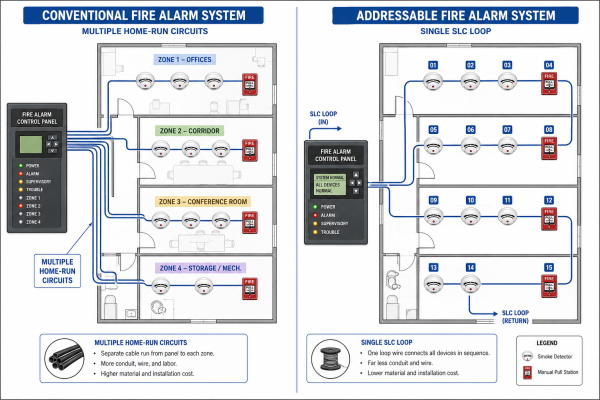
Conventional systems use dedicated home-run circuits for each zone, meaning a separate cable run must travel from the control panel to each zone’s device cluster. This wiring approach is straightforward electricians and fire alarm technicians can easily understand and troubleshoot the circuit topology. However, it becomes increasingly cumbersome as the number of zones grows. A building with twenty zones requires twenty separate cable runs back to the panel, each of which must be monitored and maintained.
The conventional fire alarm zone wiring approach also has limited supervision capability. If a wire break occurs at the end of a zone circuit, the entire zone may go into trouble or fail to respond to alarms. Locating the fault requires manual inspection of the entire zone circuit, which can be time-consuming in a large or complex installation. This limitation becomes especially problematic in buildings where wiring runs through finished walls, above drop ceilings, or through conduit that is difficult to access.
Addressable Wiring: Efficient SLC Loops, Rich Data
Addressable systems use a single signaling line circuit (SLC) that can loop through all devices in a T-tap or Class B configuration, or form a complete Class A loop that provides redundant communication paths even if the circuit is broken at any point. This architecture dramatically reduces the amount of wire required for large installations instead of twenty separate home runs, a single SLC loop can serve hundreds of devices throughout an entire building.
The fire alarm system installation process for an addressable system requires programming each device’s unique address into both the device itself (using a DIP switch, rotary dial, or software tool depending on the manufacturer) and the control panel’s configuration database. This programming step adds time and expertise to the initial installation, but it pays dividends in the form of dramatically enhanced fault isolation the panel can identify not just that a fault exists on an SLC loop but the specific segment of the loop where the fault occurred.
Key Advantages of Conventional Fire Alarm Systems
Conventional fire alarm systems remain a viable and widely used solution for certain building types and budget scenarios. Here are the most compelling advantages they offer:
- Lower upfront equipment cost: Conventional control panels and detectors are generally less expensive than their addressable counterparts, making them attractive for small-budget projects where the total device count is low.
- Simpler installation for small buildings: In a building with only two or three zones and a handful of devices per zone, the installation process is faster and requires less specialized programming knowledge.
- Easier for contractors without advanced training: The technology is mature and well-understood across the industry. A wide range of licensed fire alarm contractors can install, inspect, and service conventional systems without specialized manufacturer training.
- Fewer software dependencies: Conventional systems operate on straightforward electrical logic no firmware, no configuration databases, and no software tools are required to commission or troubleshoot a zone circuit.
- Reliable in very small occupancies: For a single-story building with a small footprint a residential care home, a small retail shop, or a compact office suite a conventional system may provide all the detection and notification capability the occupancy requires at a fraction of the cost of an addressable solution.
Key Advantages of Addressable Fire Alarm Systems
Addressable systems have become the preferred architecture for the majority of commercial and institutional applications in the modern fire protection industry. Here is why:
- Precise device-level alarm location: Emergency responders are directed to the exact device that activated, eliminating wasted time searching an entire zone and enabling faster, more targeted intervention.
- Advanced diagnostic and maintenance capabilities: Addressable panels continuously monitor each device’s sensor cleanliness and compensation levels, generating maintenance alerts before a detector becomes a nuisance alarm source or fails to respond to an actual fire.
- Scalability for large and complex buildings: A single SLC loop can support hundreds of devices, and multiple SLC loops can be added as a building expands without running additional home-run circuits to the panel.
- Sophisticated control and integration functions: Addressable systems support complex cause-and-effect programming: a single alarm input can simultaneously trigger elevator recall, HVAC shutdown, door release, selective zone notification, and alarm signal transmission to the monitoring station.
- Reduced false alarm rates: Multi-criteria addressable detectors and analog sensing technology enable the panel to distinguish between a true fire event and a nuisance condition such as steam, dust, or cooking smoke reducing costly and disruptive false alarm activations.
Cost Comparison: Conventional vs Addressable Fire Alarm Systems
Cost is invariably one of the first considerations when evaluating conventional vs addressable fire alarm systems. The cost picture is nuanced, however, and a simple comparison of panel and device prices does not tell the whole story.
Initial Equipment and Installation Costs
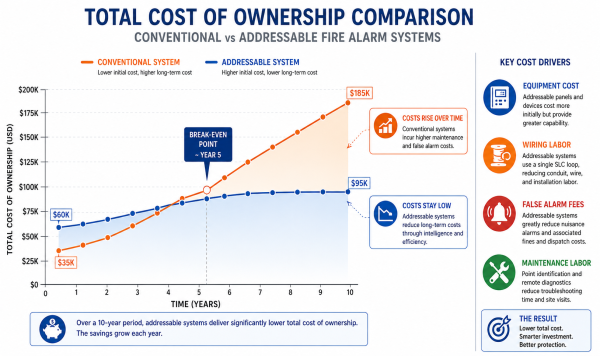
Conventional fire alarm control panels are generally less expensive than addressable panels for comparable input/output capacity. A basic conventional panel supporting four to eight zones may cost a few hundred dollars, while an entry-level addressable panel from a leading manufacturer typically starts at several hundred to over a thousand dollars. Individual conventional detectors are also typically less expensive per unit than addressable devices.
However, the fire alarm upgrade cost analysis changes significantly when you factor in wiring. Because conventional systems require a home-run circuit for each zone, labor costs for wire pulling can quickly eclipse the device savings in larger buildings. Addressable systems, with their efficient SLC loop architecture, often require substantially less wire and conduit, which can offset or even reverse the device cost differential in buildings with more than a few dozen devices.
Long-Term Operational and Maintenance Costs
Over the lifetime of the system, addressable technology tends to deliver lower operational costs. The diagnostic capabilities of an addressable fire alarm panel reduce the time a technician must spend locating and diagnosing faults during inspections a direct reduction in labor costs for the building owner. Conventional systems, which offer no device-level fault identification, require manual circuit tracing that is time-consuming and therefore expensive.
False alarm costs are another significant long-term consideration. Every false alarm activation can result in fire department response fees, business disruption, potential liability, and regulatory scrutiny. The analog sensing and multi-criteria detection capabilities of addressable devices dramatically reduce false alarm frequency a financial benefit that compounds over the years of system operation. When evaluating fire alarm upgrade cost projections, facilities that currently experience frequent false activations with a conventional system may find that an addressable upgrade pays for itself through false alarm cost avoidance within just a few years.
Code Compliance and NFPA 72 Requirements
Both conventional and addressable systems can comply with applicable fire codes when properly designed and installed. However, the NFPA 72 fire alarm requirements do introduce provisions that effectively mandate addressable systems in certain occupancies and building sizes and the regulatory trend has been moving consistently in the direction of addressable technology for several code cycles.
NFPA 72 does not universally require addressable systems, but it does impose requirements for alarm verification, pre-signal capability, and mass notification that are far easier and, in some cases, only practical to implement with addressable technology. The NFPA 72 fire alarm requirements for healthcare occupancies, high-rise buildings, and facilities with complex emergency communication needs have evolved to a point where addressable systems are effectively the only practical compliance solution.
Additionally, authorities having jurisdiction (AHJ) in many states and municipalities have adopted local amendments to NFPA 72 that explicitly require addressable systems for buildings above a certain size, height, or occupancy classification. Before committing to a conventional system design, always verify the specific requirements of your local AHJ, state fire code, and the edition of NFPA 72 currently in force in your jurisdiction. QuickShipFire’s team has extensive experience helping customers navigate these requirements, and our inventory of fire alarm panels includes both conventional and addressable options from leading manufacturers.
Building Type and Size: Which System Fits?
The right choice in the conventional vs addressable fire alarm systems debate is heavily influenced by the specific characteristics of the building being protected. There is no universal answer but there are clear patterns that make the decision straightforward in most cases.
Small Buildings: The Case for Conventional
For small, single-occupancy buildings with a limited number of rooms and a straightforward floor plan, a conventional fire alarm system is often the most practical and cost-effective choice. Think of a standalone retail shop with two or three zones, a small restaurant, a single-story office suite, or a small warehouse. In these settings, the zone-level alarm indication is entirely adequate there are few enough spaces within each zone that staff can quickly inspect the entire area when an alarm activates.
The fire alarm system for commercial buildings of this type benefits from conventional technology’s simplicity, lower equipment cost, and the wide availability of contractors who can install and service it. When budget is a primary constraint and the building does not have complex detection or control requirements, conventional is a defensible and practical choice.
Medium to Large Buildings: The Case for Addressable
As building size, complexity, and occupancy risk increase, the limitations of conventional systems become increasingly pronounced. Multi-story office buildings, schools, hotels, apartment complexes, healthcare facilities, industrial plants, and any building where rapid, precise alarm location is operationally important are all ideal candidates for addressable systems. The fire alarm system for commercial buildings with multiple wings, floors, or zones beyond eight to ten will almost always benefit from the addressable architecture’s superior fault isolation, diagnostic capability, and cause-and-effect programming flexibility.
Mixed-Use and Campus Environments
Campus environments with multiple buildings present a particularly compelling case for addressable technology. A networked addressable system can link multiple buildings to a central annunciator, providing a single monitoring point for an entire campus. This capability is simply not achievable with conventional zone-based systems, which would require a separate panel per building with no easy mechanism for centralized monitoring or coordinated response.
Maintenance and Inspection Considerations
The ongoing maintenance demands of conventional vs addressable fire alarm systems differ in ways that have real financial and operational implications for building owners and facility managers over the life of the system.
Conventional System Maintenance
Conventional fire alarm systems are relatively simple to maintain from a technical standpoint there is no software to update, no configuration database to manage, and no device addressing to verify. Annual inspection and testing under NFPA 72 requires a technician to test each detector and pull station individually, confirm that zone indicators activate correctly at the panel, and verify that notification appliances operate as intended.
The challenge with conventional maintenance is fault isolation. When a zone circuit develops a trouble condition typically due to a wiring fault, a failed device, or an end-of-line resistor issue the technician must manually trace the circuit to locate the problem. In a building where, zone circuits run through finished walls or above occupied ceilings, this can be a time-consuming and costly process. There is no way for the panel itself to narrow down the location of the fault within a zone.
Addressable System Maintenance
Addressable systems offer dramatically superior maintenance diagnostics. When a wiring fault, device failure, or communication error occurs on an SLC loop, the addressable fire alarm panel can typically identify not just that a fault exists but the specific device or segment of the loop where it has occurred. Technicians can go directly to the problem location rather than spending hours tracing circuits, dramatically reducing both labor time and disruption to building occupants.
Beyond reactive fault finding, addressable panels continuously monitor the analog sensitivity values of each detector. When a detector’s sensing chamber becomes dirty enough to affect its performance but before it reaches the threshold that would trigger a nuisance alarm the panel generates a maintenance alert, identifying the specific device by address and location. This proactive maintenance capability is one of the most compelling operational advantages of addressable technology over conventional systems.
How to Evaluate Which System Is Right for Your Building
If you are in the process of deciding between conventional and addressable technology, working through these key evaluation criteria will lead you to the right answer for your specific situation:
- Building size and zone count: If your building requires more than eight to ten zones, or if any individual zone contains more than a handful of rooms, an addressable system is almost certainly the better choice for operational response effectiveness.
- Occupancy type and life safety risk: Higher-risk occupancies healthcare, education, high-rise residential, industrial typically warrant the enhanced detection, diagnostic, and control capabilities of addressable systems, and may be required by code.
- Budget horizon: If your analysis includes long-term operational costs labor for inspections, false alarm penalties, and fault-finding time addressable systems frequently offer a lower total cost of ownership despite higher upfront equipment prices.
- Future expansion plans: If your building is likely to expand, change occupancy, or undergo renovation in the coming years, an addressable system’s scalability and flexible SLC loop architecture will be far easier to adapt than a conventional zone-based design.
- Local code requirements: Always verify the applicable edition of NFPA 72 and any local AHJ amendments before finalizing your system type selection some jurisdictions effectively mandate addressable systems for certain building classifications.
Upgrading from Conventional to Addressable: What to Expect
Many building owners operating older conventional fire alarm systems are considering an upgrade to addressable technology. Understanding what a conventional-to-addressable upgrade involves helps set realistic expectations for cost, disruption, and timeline.
Panel Replacement
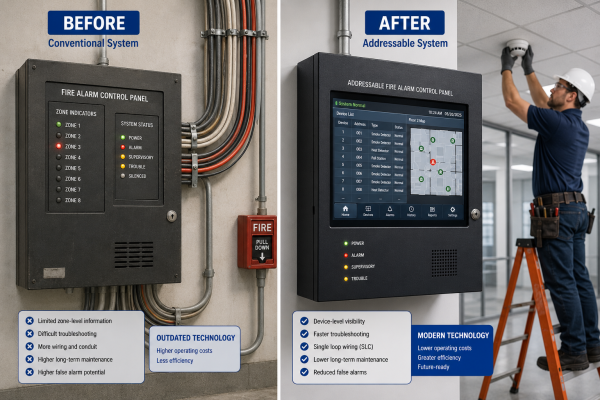
The first step in any system upgrade is replacing the fire alarm control panel. The existing conventional panel must be decommissioned and replaced with a new addressable panel typically one that is sized to support the total number of devices in the building with capacity for future expansion. QuickShipFire carries a broad selection of addressable fire alarm panels and boards from leading manufacturers including Fire-Lite, Notifier, Simplex, and Silent Knight, all of which are available new in original manufacturer packaging with fast U.S. shipping.
Device Replacement and Addressing
The existing conventional detectors and pull stations will generally need to be replaced with addressable devices, as conventional detectors cannot communicate on an SLC loop. The addressable smoke detector selected for the upgrade must be compatible with the new panel’s communication protocol, and each device must be assigned and programmed with its unique address before the system can be commissioned.
In some cases, addressable monitor modules can be used to convert existing conventional detector circuits into addressable zones, allowing the physical detectors to remain in place while the panel gains addressable supervision of the circuit. This hybrid approach can significantly reduce the cost and disruption of an upgrade project, particularly when detectors are relatively new or when the budget for a full device replacement is constrained.
Wiring Considerations
Existing conventional wiring may or may not be reusable for an addressable upgrade, depending on the wire gauge, insulation type, and the specific addressable panel’s SLC requirements. In many cases, new SLC wire must be pulled but because the addressable loop architecture requires far less wire than multiple conventional zone home-runs, this can sometimes be accomplished with minimal additional labor relative to the full zone wiring that was originally installed.
The fire alarm system installation process for an addressable upgrade should always be managed by a licensed fire alarm contractor with specific training and experience on the panel manufacturer’s equipment. Addressable system programming is more complex than conventional zone wiring, and errors in address assignment or cause-and-effect programming can result in system malfunctions that are difficult to diagnose after the fact.
Planning a fire alarm upgrade or new installation? Browse QuickShipFire’s full selection of fire alarm panels, detectors, and modules all brand new in original manufacturer packaging, with fast U.S. shipping and over 20 years of fire and life safety expertise behind every order.
Fire Detection System Types: Where Hybrid Systems Fit In
The market for fire detection system types is not limited to a binary choice between fully conventional and fully addressable architectures. Hybrid systems occupy a middle ground that can be the right answer for buildings that need some addressable capability but have constraints that make a full addressable system impractical.
A hybrid fire alarm system uses an addressable fire alarm control panel that supports both addressable SLC devices and conventional zone circuits on the same platform. This allows a building owner to upgrade the panel and the most critical areas of the building to full addressable technology while leaving lower-priority zones on conventional circuits until budget allows for a phased full-addressable completion.
Understanding the full range of fire detection system types conventional, addressable, hybrid, wireless, and aspirating is important context when making a system selection decision. For the vast majority of commercial and institutional buildings, the choice ultimately narrows to conventional or addressable based on building size, budget, and code requirements. But knowing that hybrid and specialty systems exist can open up additional options when standard solutions do not perfectly fit the situation.
Common Mistakes When Choosing Between Conventional and Addressable Systems
Informed decision-making in the conventional vs addressable fire alarm systems debate requires avoiding these frequently made mistakes:
- Basing the decision on upfront device cost alone: Failing to account for wiring labor, long-term maintenance, false alarm costs, and scalability leads many building owners to underestimate the total cost advantage that addressable systems deliver over time.
- Undersizing the zone count for a conventional system: Designing a conventional system with too few zones to reduce panel cost results in excessively large zones that make alarm localization slow and impractical, undermining the core purpose of the system.
- Ignoring local code requirements: Installing a conventional system without first verifying local AHJ requirements or the applicable NFPA 72 edition can result in a code-non-compliant installation that fails inspection and requires costly replacement.
- Choosing incompatible addressable devices: In addressable systems, devices must be specifically compatible with the control panel’s communication protocol. Mixing devices from different manufacturers without verifying protocol compatibility is a leading cause of addressable system malfunctions.
- Failing to plan for future expansion: Installing a conventional system in a building that is likely to expand or undergo renovation without accounting for the difficulty of adding zones creates a planning problem that can be expensive to resolve later.
Sourcing Equipment for Conventional and Addressable Fire Alarm Systems
Regardless of which system type is right for your building, sourcing reliable, properly listed equipment from a trustworthy supplier is one of the most important steps in the process. All devices installed in a fire alarm system must carry a listing from a nationally recognized testing laboratory (NRTL) in most cases, Underwriters Laboratories (UL) and must be compatible with the specific control panel in the installation.
QuickShipFire has been serving fire safety professionals, facility managers, and building owners since 2017, specializing in both current-production and hard-to-find fire alarm components from leading manufacturers. Whether you are sourcing a complete smoke detector package for a new addressable installation or tracking down replacement parts for an aging conventional system, our inventory and our team are equipped to help.
We carry products from Fire-Lite, Notifier, Simplex, Silent Knight, System Sensor, Gamewell-FCI, Wheelock, and other trusted brands all brand new in original manufacturer packaging. If you are evaluating conventional vs addressable fire alarm systems for your next project and need guidance on which panels and devices best suit your requirements, our technical team is available to assist with compatibility verification, product selection, and sourcing for both standard and obsolete components.
The Future of Fire Alarm Technology: Where Is the Industry Heading?
The fire alarm industry has been moving steadily toward addressable and intelligent systems for more than two decades, and that trajectory shows no signs of reversing. While the conventional vs addressable fire alarm systems debate remains relevant today conventional systems continue to be sold and installed in appropriate applications the long-term direction of the industry is clear.
Modern addressable systems are increasingly incorporating IP-based network communications, cloud-connected monitoring platforms, integration with building automation systems, and predictive maintenance analytics powered by sensor data. The intelligent fire alarm systems of the next decade will leverage the device-level data that addressable technology makes available to drive deeper operational insights, faster response times, and lower false alarm rates than anything currently achievable with conventional infrastructure.
For building owners planning a long-term investment in fire protection infrastructure, the practical implication is clear: if your building and budget support an addressable system today, investing in that architecture positions you better for future technology integration and code compliance evolution. Conventional systems, while still appropriate for small and simple applications, offer no upgrade path to these emerging intelligent capabilities.
Side-by-Side Summary: Conventional vs Addressable Fire Alarm Systems
Here is a concise side-by-side summary of the key differentiating factors to support your final decision:
- Alarm location precision: Conventional provides zone-level indication; addressable provides exact device identification down to a single detector or pull station.
- Installation complexity: Conventional is simpler to wire for small zone counts; addressable requires device programming but uses significantly less wire for larger installations.
- Equipment cost: Conventional panels and devices have lower per-unit prices; addressable systems offer lower total cost of ownership at medium-to-large scale when wiring and operational savings are factored in.
- Maintenance and diagnostics: Conventional require manual circuit tracing for fault isolation; addressable panels provide device-level fault identification and proactive dirty detector alerts.
- Scalability and integration: Conventional systems scale poorly beyond moderate zone counts and offer limited integration capability; addressable systems support hundreds of devices per SLC loop and rich cause-and-effect programming for building system integration.
Ready to move forward with the right fire alarm system for your building? Contact QuickShipFire today our fire safety specialists have over 20 years of experience helping customers across the United States select, source, and install the right conventional or addressable fire alarm equipment for their specific building and compliance requirements.
Conclusion
The decision between conventional vs addressable fire alarm systems is ultimately a function of your building’s size and complexity, your occupancy type and life safety risk profile, your budget horizon, and the specific requirements of the codes and authorities governing your jurisdiction. Neither system type is universally superior the right answer depends on the specific context of your project.
For small, simple buildings with limited zone counts and modest budgets, conventional systems deliver reliable, code-compliant fire protection at the lowest possible cost. For medium to large buildings, complex occupancies, and any facility where rapid and precise alarm location is operationally important, addressable systems deliver a level of capability, diagnostics, and integration that conventional technology simply cannot match.
What remains constant in both cases is the importance of sourcing quality equipment, working with trained and licensed contractors, and maintaining the system rigorously throughout its service life. QuickShipFire is here to support every step of that process from initial equipment selection and sourcing through long-term parts availability for systems of any age. Explore our full product catalog and let us help you build a fire alarm system that protects your building, satisfies your code requirements, and serves your occupants reliably for years to come.
Frequently Asked Questions (FAQs)
1. What is the main difference between conventional and addressable fire alarm systems?
The core difference lies in how individual devices communicate with the fire alarm control panel. In a conventional system, all devices within a zone share a single circuit, and the panel can only identify which zone triggered an alarm not which specific device. In an addressable system, every device has a unique digital address and communicates individually with the panel, which can identify exactly which device activated and where it is located in the building. This device-level precision is the defining advantage of addressable technology.
2. Which type of fire alarm system is required by NFPA 72?
NFPA 72 does not categorically require addressable systems for all buildings, but its requirements for alarm verification, selective notification, and mass notification in larger and higher-risk occupancies effectively mandate addressable technology in those contexts. Many local authorities having jurisdiction (AHJ) have also adopted amendments that explicitly require addressable systems for buildings above a certain size, height, or occupancy classification. Always verify your specific local requirements before finalizing a system type selection.
3. Are addressable fire alarm systems more expensive than conventional?
Addressable panels and individual devices typically carry higher per-unit prices than conventional equipment. However, the total installed cost comparison is more complex. Addressable systems require significantly less wire for medium to large installations, which can reduce wiring labor costs substantially. Over the system’s lifetime, addressable technology also delivers lower maintenance labor costs through superior fault diagnostics and reduced false alarm frequency. At medium-to-large scale, addressable systems often have a lower total cost of ownership than conventional systems when all factors are accounted for.
4. Can I mix conventional and addressable devices on the same fire alarm system?
Yes, through the use of addressable monitor modules and zone input modules, it is possible to connect conventional detector circuits to an addressable fire alarm control panel. This hybrid configuration allows the panel to supervise the conventional zone as an addressable input, providing zone-level (rather than device-level) identification for those circuits. Some addressable panels also include dedicated conventional zone inputs alongside their SLC ports, specifically to support phased upgrades or to accommodate legacy device installations.
5. How many devices can an addressable fire alarm system support?
The device capacity of an addressable system depends on the specific control panel model and the number of signaling line circuit (SLC) loops it supports. A typical SLC loop on a mid-range addressable panel can support between 99 and 254 addressable devices, depending on the protocol. Panels with multiple SLC loops can support many hundreds or even thousands of devices across a large campus or building complex. This scalability is one of the most significant practical advantages of addressable architecture over conventional zone-based systems.
6. What happens to an addressable system if the SLC loop wiring is cut or damaged?
The impact of a wiring fault on an addressable SLC loop depends on the wiring configuration used. In a Class B (Style 4) configuration, a single open or short fault on the loop will cause devices beyond the fault point to go offline, resulting in a supervisory trouble condition at the panel. In a Class A (Style 6 or 7) configuration, the loop is wired as a continuous circuit with both ends returning to the panel, providing redundant communication paths so that even a single open fault does not disable any devices. Class A wiring is strongly recommended for critical occupancies and is required in certain healthcare and high-rise applications.
7. How do I know whether my building needs a conventional or addressable fire alarm system?
The key factors to evaluate are building size and number of zones required, occupancy type and life safety risk level, applicable local codes and AHJ requirements, budget for both initial installation and long-term maintenance, and whether the building is likely to expand or change occupancy in the coming years. As a general rule, buildings that require more than eight to ten zones, have complex occupancies, house vulnerable populations, or are subject to high-risk code classifications will benefit from and may be required to have an addressable fire alarm system. Consulting with a licensed fire protection engineer and a reputable equipment supplier like QuickShipFire is the most reliable way to reach the right decision for your specific situation.