

When it comes to building safety, one of the most overlooked yet legally critical areas is ensuring that fire alarm systems are accessible to everyone, including people with hearing disabilities. ADA fire alarm requirements mandate the use of visual notification devices such as strobes and flashing lights alongside traditional audible alarms, ensuring that every occupant receives adequate warning in an emergency. If your facility is not yet compliant, exploring the fire alarm notification modules and devices available at QuickShipFire is an excellent starting point for finding the right equipment quickly and affordably.
The Americans with Disabilities Act (ADA) was signed into law in 1990 and has since established comprehensive standards that affect how public accommodations, commercial buildings, and multi-family housing address the needs of individuals with disabilities. Fire alarm systems are a specific focus area under the ADA, particularly for those who are deaf or hard of hearing. In this article, we will walk you through everything you need to know about ADA fire alarm requirements, including which visual notification devices are required, where they must be installed, how they must perform, and what building owners and facility managers need to do to maintain full compliance.
What Are ADA Fire Alarm Requirements?
The ADA fire alarm requirements are a set of federal accessibility standards that govern how fire alarm systems must operate in facilities covered by the Americans with Disabilities Act. These requirements are primarily detailed in the ADA Standards for Accessible Design (ADASAD), which are enforced by the U.S. Department of Justice and the U.S. Access Board.
At the core of these requirements is the mandate that fire alarm systems must provide both audible and visible alarm notification. An audible alarm alone is insufficient in a space where deaf or hard-of-hearing individuals may be present. Visual notification devices, most commonly strobe lights, must flash at a specific frequency and intensity to ensure they are noticeable even during daylight hours or in brightly lit environments.
It is important to understand that ADA fire alarm requirements do not stand alone. They are implemented in conjunction with the National Fire Alarm and Signaling Code (NFPA 72) and the International Building Code (IBC), creating a layered framework that building professionals must navigate together. Non-compliance can result in costly fines, legal liability, and most importantly, endangerment of building occupants.
Who Must Comply with ADA Fire Alarm Requirements?
Not every building type is subject to the same level of ADA compliance, but the reach of these regulations is quite broad. Generally, any facility that is a place of public accommodation, a commercial facility, or a state or local government entity must comply with ADA fire alarm requirements. This includes:
- Hotels, motels, and places of lodging: including sleeping rooms and public corridors
- Offices and commercial buildings: common areas, restrooms, and corridors
- Healthcare facilities: patient rooms, waiting areas, and public spaces
- Educational institutions: classrooms, libraries, gymnasiums, and dormitories
- Retail establishments and restaurants: any customer-accessible area
For residential buildings, the Fair Housing Act (FHA) and the ADA Accessibility Guidelines (ADAAG) also require visual alarm notification systems in certain dwelling units, especially those designed for or occupied by individuals with hearing impairments. Multi-family housing projects with four or more units have specific provisions that facility managers must address.
Understanding Visual Notification Devices Under ADA
Visual notification devices are the cornerstone of ADA fire alarm requirements for hearing-impaired individuals. These devices are designed to emit a bright, visible flash that alerts occupants to a fire emergency when they may not be able to hear the audible alarm. Understanding the technical requirements for these devices is essential to ensuring proper compliance.
Strobe Light Standards
The ADA and NFPA 72 specify that strobe lights used for fire alarm notification must flash at a rate of one to two flashes per second (1 to 2 Hz). The intensity of the light must be at least 75 candela for most general-use spaces, although higher intensities may be required for larger rooms or spaces with high ambient light levels. The flash duration must be less than two-tenths of a second (0.2 seconds) to avoid triggering photosensitive epilepsy in susceptible individuals.
Color and Lens Requirements
Under ADA fire alarm requirements, strobe lights must produce a clear or white light unless the authority having jurisdiction (AHJ) approves an alternative. The lens must be clear or nominal white, and the strobe must be visible from the required coverage areas without obstruction. The use of red strobes is allowed in some jurisdictions but is not the ADA default standard.
Wall-Mounted vs. Ceiling-Mounted Devices
The mounting height of visual notification devices is also regulated under ADA fire alarm requirements. Wall-mounted devices must be installed with the top of the appliance not more than 96 inches (8 feet) from the finished floor. If ceiling-mounted, different intensity and coverage requirements apply. In corridors less than 20 feet wide, one strobe may cover up to 100 feet of corridor length when placed at the midpoint.
Key ADA Visual Notification Device Placement Rules
Proper placement of visual notification devices is critical to achieving compliance. Here are the essential placement rules you need to know:
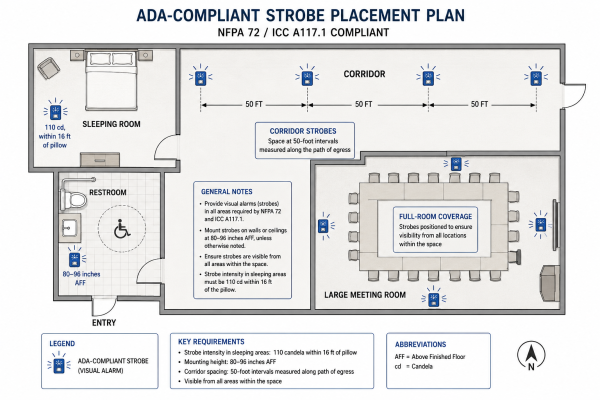
- Sleeping rooms: Must have wall-mounted strobes within 16 feet of the pillow location, with a minimum intensity of 110 candela.
- Corridors: Single strobes must cover no more than 50 feet of corridor unless placed at midpoints, in which case up to 100 feet of coverage is permitted.
- Large rooms (exceeding 100 square feet): Require strobes positioned so the entire space is within the field of coverage; multiple units may be needed.
- Restrooms: All accessible restrooms must have visual notification devices mounted 80 to 96 inches above the finished floor.
- Mechanical rooms and storage areas: Where employees or visitors may be present, visual devices must be installed even if the space is not typically occupied continuously.
NFPA 72 and Its Relationship to ADA Fire Alarm Requirements
While the ADA establishes the legal framework for accessibility, NFPA 72 the National Fire Alarm and Signaling Code provides the technical specifications that govern how fire alarm systems must be designed and installed. These two standards work together and must both be satisfied to achieve full compliance with ADA fire alarm requirements.
NFPA 72 specifies detailed requirements for notification appliance circuits (NAC), wiring standards, power supply redundancy, and the performance of visual and audible devices. It is updated on a regular cycle (typically every three years), and jurisdictions may adopt different editions of the code. Building owners and fire safety professionals must always verify which edition of NFPA 72 is in effect in their jurisdiction.
One area where NFPA 72 and ADA fire alarm requirements intersect is in the requirement for synchronized strobes. When multiple strobe lights are visible from the same location, NFPA 72 requires that they be synchronized to flash simultaneously. Unsynchronized strobes can create a rapid flickering effect that may trigger seizures in individuals with photosensitive epilepsy, posing a serious safety and liability concern.
At QuickShipFire, we carry a wide range of fire alarm panels and control systems that support synchronized NAC outputs, making it straightforward to meet both ADA and NFPA 72 requirements for visual notification devices.
Common Areas That Require Visual Notification Devices
One of the most common compliance mistakes is failing to install visual notification devices in all required locations. The ADA fire alarm requirements identify specific areas where visual alarms are mandatory. Below are the most frequently referenced common areas:
Hotel and Motel Guest Rooms
Under ADA Standards for Accessible Design, hotels and motels must provide a minimum percentage of accessible guest rooms equipped with visual notification devices. These include visual alarm strobes in the sleeping area, bathroom, and any other room in the unit. The percentage of required accessible rooms varies based on the total room count of the facility.
Restrooms and Locker Rooms
Any restroom or locker room accessible to the public or employees must have a visual notification device. The device must be mounted between 80 and 96 inches above the finished floor. This ensures it is visible over stall partitions and other obstructions within the space.
Meeting Rooms and Auditoriums
Large assembly spaces such as conference rooms, auditoriums, and lecture halls require careful planning for visual alarm coverage. ADA fire alarm requirements stipulate that strobes must be positioned so that every occupant has a direct line of sight to at least one strobe device without needing to turn more than 90 degrees from any seated position.
Corridors and Hallways
Corridors require visual notification devices at regular intervals to ensure continuous coverage throughout the escape route. Devices must not be spaced more than 100 feet apart in a corridor with ceiling-mounted devices, and 50 feet from the last strobe to the end of any corridor.
Technical Specifications Summary for ADA-Compliant Strobes
To help you quickly reference the most important technical parameters, here is a summary of the key specifications required for ADA-compliant visual notification devices:
- Flash rate: 1 to 2 flashes per second (1–2 Hz)
- Minimum candela: 75 cd for general areas; 110 cd for sleeping rooms
- Flash duration: Must be less than 0.2 seconds per flash
- Lens color: Clear or nominal white (unless AHJ approves otherwise)
- Mounting height (wall): Top of device must be between 80 and 96 inches from finished floor
- Synchronization: Required when multiple strobes are visible from the same location
How to Choose the Right Visual Notification Devices for ADA Compliance
Selecting the right visual notification devices for your facility requires careful consideration of room dimensions, occupancy type, existing fire alarm infrastructure, and the edition of NFPA 72 adopted in your jurisdiction. Here are the key factors to evaluate when making your selection:
Candela Rating and Room Size
The candela rating of a strobe device determines how large a room it can effectively cover. Larger rooms require higher candela ratings or additional devices. NFPA 72 provides detailed tables that correlate room size with minimum candela requirements. Always consult these tables when specifying devices for ADA fire alarm requirements compliance.
Compatibility with Your Existing Fire Alarm Panel
Not all visual notification devices are compatible with every fire alarm panel or NAC circuit. It is critical to verify that the devices you select are compatible with your existing fire alarm control panel to ensure proper operation and avoid nuisance trips or device failures. QuickShipFire’s technical team can assist you in matching devices to your specific system.
Indoor vs. Outdoor Ratings
Visual notification devices for outdoor or wet locations must carry appropriate environmental ratings (typically IP or NEMA ratings) to withstand exposure to moisture, dust, and temperature extremes. Indoor devices used in standard commercial applications are rated for dry locations only and must not be installed in environments where they may be exposed to the elements.
Ready to upgrade your fire alarm system for ADA compliance? Browse QuickShipFire’s full selection of notification modules and devices to find the right visual alarm strobes for your building with fast U.S. shipping and expert support available every step of the way.
ADA Fire Alarm Requirements for New Construction vs. Existing Buildings
One of the most common questions facility managers and building owners ask is whether ADA fire alarm requirements apply differently to new construction versus existing buildings. The answer is yes, but both are still subject to significant obligations.
New Construction
For new construction, full compliance with ADA Standards for Accessible Design is mandatory from the outset. Every element of the fire alarm system, including visual notification devices, must meet the current ADA standards and applicable NFPA 72 edition. There is no grandfather provision or phased-in compliance period for new builds compliance is a condition of obtaining a certificate of occupancy.
Existing Buildings and Alterations
Existing buildings are required to comply with ADA fire alarm requirements when they undergo alterations or renovations. When a facility is altered in a way that affects the usability of the space such as expanding a floor plan, renovating restrooms, or updating fire alarm wiring the altered areas must be brought into compliance with current ADA standards. If the alteration involves the fire alarm system itself, the entire system upgrade must be ADA compliant.
Even without a formal renovation, existing facilities may be required to make changes under the ADA’s “readily achievable barrier removal” standard. This means that if visual notification devices can be added without significant difficulty or expense, building owners are legally obligated to do so. Courts and the Department of Justice have consistently interpreted this standard broadly, so it is in every facility owner’s interest to proactively assess their ADA fire alarm compliance.
Steps to Achieving ADA Fire Alarm Compliance
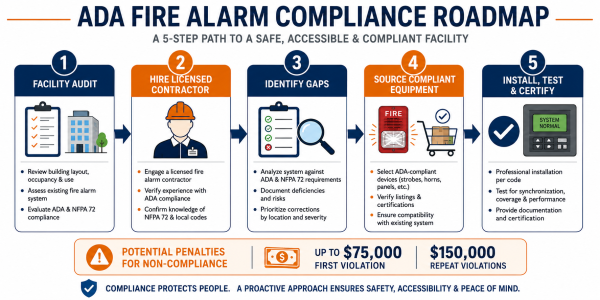
Taking a systematic approach to ADA compliance can help you avoid costly mistakes. Here is a step-by-step overview of what the compliance process typically looks like:
- Conduct a facility audit: Walk through your building and document all areas where fire alarm devices are installed, as well as all occupied areas where devices may be missing.
- Engage a licensed fire alarm contractor: Work with a professional who is familiar with both NFPA 72 and ADA standards in your jurisdiction.
- Identify gaps and develop a remediation plan: Based on the audit findings, determine what devices need to be added, upgraded, or relocated.
- Source compliant equipment: Purchase ADA-compliant visual notification devices from a trusted supplier. QuickShipFire carries a broad inventory of fire alarm notification devices from leading manufacturers.
- Install and test: Have the devices installed by a licensed contractor and test the entire system to verify synchronization, coverage, and proper operation before seeking final inspection approval.
Enforcement and Penalties for Non-Compliance
Failure to comply with ADA fire alarm requirements can have serious consequences. The U.S. Department of Justice has authority to investigate complaints, conduct compliance reviews, and initiate litigation against non-compliant facilities. Civil monetary penalties for first-time violations can reach up to $75,000, with repeat violations subject to penalties of up to $150,000.
Beyond government enforcement, private individuals can also file lawsuits against facilities that fail to comply with the ADA. Attorneys’ fees, injunctive relief, and compensatory damages can add significantly to the cost of non-compliance. Many high-profile ADA lawsuits have resulted from inadequate fire alarm notification systems, making this an area of genuine legal exposure for building owners and property managers.
It is also worth noting that local fire marshals and building inspectors may identify ADA fire alarm requirements violations during routine inspections. A failure notice from a local authority can trigger immediate remediation requirements, temporary occupancy restrictions, and reputational harm to a business or institution.
Maintenance and Testing of ADA-Compliant Visual Notification Devices
Installing compliant visual notification devices is not a one-time task. ADA fire alarm requirements imply an ongoing obligation to maintain the system in proper working order. NFPA 72 establishes clear testing and inspection requirements for all fire alarm components, including visual notification devices.
Strobe lights must be visually inspected annually and functionally tested to confirm they operate at the correct flash rate and intensity. Any device found to be malfunctioning during inspection must be replaced promptly. Keeping detailed maintenance records is also essential in the event of a regulatory audit or legal dispute, documentation of regular inspections and repairs can be a critical defense.
For facilities that rely on older fire alarm infrastructure, it may be worth considering a system-wide evaluation. QuickShipFire specializes in hard-to-find and obsolete fire alarm components, making it possible to source replacement strobes and notification appliances for systems that are no longer actively supported by manufacturers.
Frequently Made Mistakes in ADA Visual Alarm Compliance
Even well-intentioned facilities can fall short of compliance due to common oversights. Here are the most frequently made mistakes to avoid:
- Installing strobes without synchronization: Multiple strobes in the same field of view that are not synchronized can trigger seizures and indicate non-compliance with NFPA 72.
- Insufficient candela for the room size: Using a 75-cd strobe in a large ballroom or open-plan office that requires a higher rating is a common and costly error.
- Skipping restrooms and utility rooms: Facilities often overlook the requirement for visual alarms in restrooms, break rooms, and storage areas where employees spend time.
- Incorrect mounting height: Mounting strobes too high or too low relative to the 80–96 inch ADA window reduces effectiveness and can trigger inspection failures.
- Failing to update systems after renovations: Any alteration that affects the building layout should trigger a review of the fire alarm system for updated ADA compliance.
The Role of Fire Alarm Panels in ADA Compliance
The fire alarm control panel (FACP) is the brain of your fire alarm system, and its capabilities have a direct impact on your ability to meet ADA fire alarm requirements. Modern addressable fire alarm panels support individual device supervision, synchronized NAC circuits, and detailed event logging all of which are essential for managing a compliant visual notification system.
When selecting or upgrading your fire alarm control panel, look for models that support NAC synchronization protocols compatible with the strobe devices you plan to use. Incompatible synchronization protocols between a panel and its notification appliances are a leading cause of compliance failures during inspection. QuickShipFire carries trusted fire alarm panels and boards from leading manufacturers including Fire-Lite, Notifier, Simplex, and Silent Knight all capable of supporting ADA-compliant visual notification systems.
For facilities with complex layouts or multiple buildings, it may also be worth exploring photoelectric smoke detectors and early detection devices that integrate seamlessly with your control panel to provide a comprehensive, ADA-compliant safety ecosystem.
Need help selecting a fire alarm panel that supports ADA-compliant visual notification? Contact the QuickShipFire team today our fire safety experts have over 20 years of experience helping facilities source the right components for compliant, reliable fire alarm systems.
Conclusion
Ensuring your building meets ADA fire alarm requirements is not just a legal obligation it is a fundamental commitment to the safety and dignity of every person who enters your facility. Visual notification devices such as strobe lights play a critical role in alerting deaf and hard-of-hearing occupants to fire emergencies, and their proper installation, placement, and maintenance are non-negotiable under the Americans with Disabilities Act and NFPA 72.
From understanding which buildings must comply, to selecting the right candela-rated strobes, to maintaining your system through regular inspections, achieving and sustaining ADA fire alarm requirements compliance is a multi-step process that rewards proactive attention. Whether you are equipping a new build or bringing an older facility up to standard, sourcing the correct equipment from a trusted supplier is one of the most important steps you can take.
QuickShipFire is proud to support fire safety professionals, facility managers, and building owners across the United States with a comprehensive inventory of fire alarm components, fast shipping, and unmatched technical support. Explore our full product catalog and let us help you build a safer, more compliant fire alarm system today.
Frequently Asked Questions (FAQs)
1. What are ADA fire alarm requirements for visual notification devices?
ADA fire alarm requirements mandate that fire alarm systems include visual notification devices typically strobe lights in all areas where deaf or hard-of-hearing individuals may be present. These devices must flash at a rate of 1 to 2 Hz, emit at least 75 candela (110 cd for sleeping rooms), and be synchronized when multiple strobes are visible from the same location. The requirements apply to all places of public accommodation, commercial facilities, and state and local government buildings covered by the ADA.
2. Do ADA fire alarm requirements apply to existing buildings?
Yes. While new construction must meet full ADA compliance from the outset, existing buildings are required to comply when undergoing alterations or renovations that affect usability. Additionally, the ADA’s “readily achievable barrier removal” standard may require existing buildings to add visual notification devices even without a formal renovation, if doing so is not excessively difficult or expensive. Facility owners should conduct regular audits to assess their ongoing compliance obligations.
3. What is the minimum candela rating required by ADA for strobe lights?
The minimum candela rating for ADA-compliant strobe lights is 75 candela (cd) for general use areas, such as corridors, meeting rooms, and restrooms. For sleeping rooms in hotels, dormitories, and healthcare facilities, the minimum rating increases to 110 candela. For very large spaces, higher ratings or multiple devices may be required based on the room dimension tables provided in NFPA 72.
4. What is the required mounting height for ADA visual alarm strobes?
Wall-mounted visual notification devices must be installed so that the top of the appliance is between 80 and 96 inches (6 feet 8 inches to 8 feet) above the finished floor. This ensures the strobe is at a height where it can be seen by occupants standing or seated in various positions throughout the room. Ceiling-mounted devices have different intensity and coverage requirements and are governed by the applicable tables in NFPA 72.
5. Are strobe lights required in restrooms under ADA fire alarm requirements?
Yes. All restrooms and locker rooms that are accessible to employees or the public must have visual notification devices installed in compliance with ADA fire alarm requirements. This includes single-occupancy restrooms and multi-stall facilities. The devices must be mounted at the appropriate height and meet the applicable candela rating for the size of the space.
6. What happens if my building fails to meet ADA fire alarm requirements?
Failure to comply with ADA fire alarm requirements can result in federal enforcement action by the U.S. Department of Justice, including civil monetary penalties of up to $75,000 for first violations and up to $150,000 for repeat violations. Private lawsuits from affected individuals are also possible, and local fire marshals may issue citations or occupancy restrictions following routine inspections. Proactive compliance is far less costly than enforcement-driven remediation.
7. Do ADA fire alarm requirements require strobes to be synchronized?
Yes. NFPA 72, which works in conjunction with ADA fire alarm requirements, mandates that visual notification devices visible from the same location must be synchronized to flash simultaneously. Unsynchronized strobes create a rapid, irregular flickering effect that can trigger photosensitive epilepsy and is considered a code violation. Most modern fire alarm control panels support NAC synchronization protocols to meet this requirement, and it is important to verify compatibility between your panel and the strobe devices you install.