
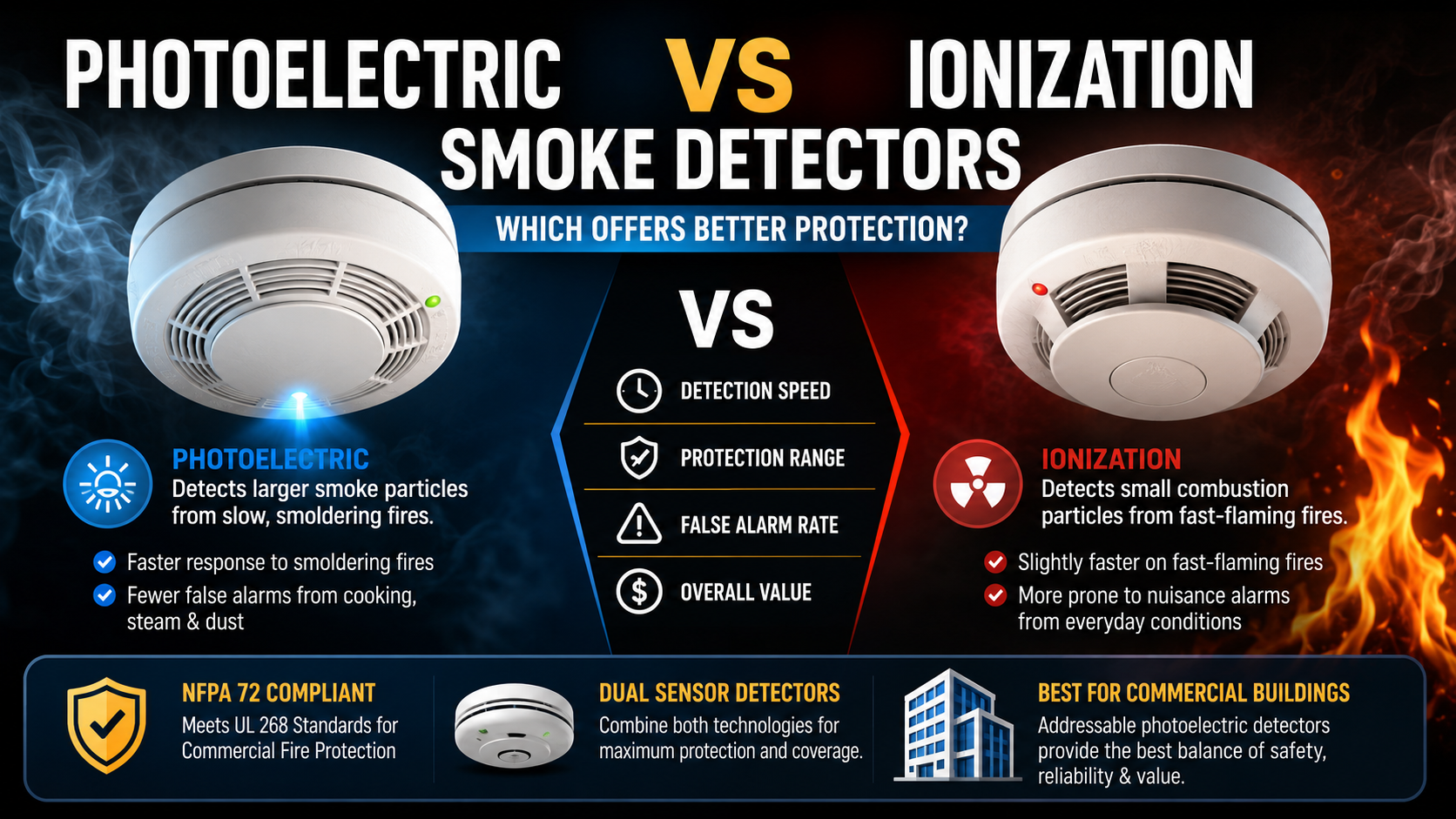
Smoke detection is the first line of defense in any building fire safety plan but not all smoke detectors respond to fire the same way. The debate over photoelectric vs ionization smoke detectors is one of the most important conversations in fire safety, yet many facility managers, building owners, and contractors still choose a detector type without fully understanding what they’re actually buying.
These two technologies detect smoke through completely different physical mechanisms. One excels at catching slow, smoldering fires that build up gradually over hours. The other responds faster to quick-flaming fires that produce intense heat and smaller combustion particles. Choosing the wrong type for your specific environment isn’t just a minor inconvenience in a genuine fire emergency, it can mean the difference between early warning and a delayed alarm.
In this guide, we break down exactly how each technology works, how they perform across different fire scenarios, what the data says about false alarm rates, when a dual sensor approach makes sense, and critically which detector type is right for commercial applications. By the end, you’ll have everything you need to make a confident, well-informed decision.
Understanding the Two Core Detection Technologies
Before comparing performance, it helps to understand the physics behind each technology. These aren’t just different brands or price tiers they operate on fundamentally different scientific principles, which is why they behave so differently in real fire conditions.
How Photoelectric Smoke Detectors Work
A photoelectric smoke detector operates on the principle of light scattering. Inside the detection chamber, a light source typically an LED is aimed at an angle away from a photosensor. Under normal conditions, the light travels across the chamber without reaching the sensor.
When smoke particles enter the light scattering chamber, they scatter the LED beam in multiple directions, redirecting some of that light onto the photosensor. When the sensor registers enough scattered light meaning enough smoke density is present it triggers the alarm.
This design makes photoelectric detectors particularly sensitive to large combustion particles, which are characteristic of slow, smoldering fires. Think of a cigarette left burning on upholstery, overheated wiring inside a wall, or a fire that builds up gradually with dense, visible smoke before open flames appear. These are precisely the scenarios where photoelectric technology excels and where an early warning can provide critical evacuation time.
How Ionization Smoke Detectors Work
An ionization smoke detector uses a fundamentally different approach: radioactive ionization. Inside the detector’s ionization chamber, a tiny amount of Americium-241 a radioactive element emits alpha particles that ionize the air between two electrically charged plates, creating a small, continuous electrical current.
When combustion particles from a fire enter the chamber, they attach to the ionized air molecules and disrupt this current. The detector’s circuitry senses the drop in current and triggers the alarm. Because ionization detectors respond to the tiny, invisible combustion particles produced by fast-flaming fires fires that burn hot and rapid with small particle output they can respond slightly faster than photoelectric detectors to this specific fire type.
The trade off: ionization chambers are also sensitive to minor air disturbances, cooking aerosols, steam, and dust making them significantly more prone to nuisance alarms in everyday commercial environments.
How Each Type Responds to Different Fire Scenarios
The performance gap between these two technologies becomes clear when you map them against the real-world fires they’re most likely to encounter. Here’s a direct comparison across four common fire scenarios:
| Fire Scenario | Photoelectric | Ionization | Why It Matters |
| Slow smoldering fire (upholstery, wiring) | ✔ Faster | ✘ Slower | Smoldering fires produce large particles photoelectric detects them first |
| Fast flaming fire (paper, cooking oils) | ✔ Comparable | ✔ Slightly faster | Ionization detects tiny high-heat particles marginally quicker |
| Kitchen / cooking steam | ✔ Fewer false alarms | ✘ More false alarms | Ionization triggers on steam & cooking aerosols more readily |
| Electrical fire in walls | ✔ Much faster | ✘ Much slower | Electrical fires smolder for hours photoelectric critical advantage |
One data point worth highlighting: according to fire safety research and NFPA incident reports, smoldering fires account for a significant proportion of nighttime residential and commercial fire deaths precisely because they build slowly and victims are often asleep or unaware. This is a key reason why photoelectric technology has gained ground in official recommendations over the past decade.
False Alarm Rates: A Critical Performance Factor
False alarms aren’t just inconvenient in commercial buildings they carry real operational and financial costs. Every unnecessary evacuation disrupts productivity, risks liability, and in jurisdictions that charge for repeated false fire department responses, can result in fines that add up quickly. Photoelectric smoke detector sensitivity is better calibrated for commercial environments precisely because it filters out the everyday non-fire triggers that ionization chambers react to.
Common false alarm triggers for ionization detectors include:
- Cooking aerosols and steam from commercial kitchens, break rooms, and cafeterias
- Dust and particulate matter in manufacturing, warehouse, or renovation environments
- High humidity and steam from bathrooms, showers, or industrial processes
- Exhaust fumes in loading docks or vehicle access areas
In contrast, photoelectric detectors are significantly less reactive to these everyday conditions, making them the preferred choice for facilities where false alarms are a recurring problem. If you manage a commercial kitchen, hotel, hospital, or industrial facility, this distinction alone often drives the technology decision.
Dual Sensor Smoke Detectors: The Best of Both Worlds?
A dual sensor smoke detector also called a multi-criteria or combination detector integrates both a photoelectric optical chamber and an ionization cell into a single detector head. The device uses its onboard microprocessor to evaluate data from both sensors simultaneously, triggering an alarm only when the combined readings exceed the alarm threshold.
The appeal is straightforward: you get broad-spectrum detection coverage across both slow smoldering and fast flaming fire types, in a single device. This eliminates the need to choose between technologies when your environment presents mixed or uncertain fire risk profiles.
In commercial applications, dual sensor detectors are particularly valuable in settings like:
- Mixed-use commercial buildings with diverse occupancies on different floors
- Retail environments where both stock storage and customer-facing spaces must be protected
- Educational facilities where varied room types from labs to gymnasiums create different fire risk profiles
- Any setting where the facility manager is uncertain about the dominant fire risk type
The trade-off: dual sensor units cost more than single-technology detectors, and in some cases their false alarm immunity isn’t as strong as a well-placed photoelectric-only unit. For most commercial applications, a well-designed photoelectric system addresses the majority of real-world scenarios but dual sensor detectors remain a strong option where risk profiles are genuinely mixed.
Photoelectric Smoke Detectors in Commercial and Industrial Settings
For commercial buildings, the case for photoelectric technology is particularly strong. Beyond the false alarm advantages, modern addressable photoelectric smoke detectors deliver a layer of operational intelligence that ionization units simply cannot match. Each detector continuously reports analog sensitivity data back to the fire alarm control panel, allowing the system to monitor smoke density in real time and flag a detector that’s drifting toward alarm before it actually false-fires.
This drift compensation capability built into most modern addressable photoelectric detectors is one of the most underappreciated advantages in commercial fire protection. It dramatically reduces nuisance alarms caused by gradual contamination of the detection chamber, extends the effective service life of each detector, and makes annual sensitivity testing faster and more reliable.
The photoelectric smoke detector commercial advantage is also clear in terms of code compliance. Most modern NFPA 72-compliant commercial installations use addressable photoelectric detectors as their primary smoke detection technology, with heat detectors or specialty devices added for specific hazard areas like mechanical rooms, kitchens, or high-ceiling warehouses.
What NFPA Recommends About Smoke Detector Technology
NFPA the National Fire Protection Association publishes NFPA 72: National Fire Alarm and Signaling Code, which governs all commercial fire alarm installations in the United States. While NFPA 72 does not explicitly mandate photoelectric over ionization technology for all applications, the organization’s research and guidance documentation has consistently pointed toward photoelectric as the preferred technology for most residential and many commercial occupancies particularly those at elevated risk of smoldering fire.
Several key NFPA positions worth knowing:
- Combination or photoelectric preferred: NFPA research indicates photoelectric detectors or combination units are more effective across the range of real-world fire types encountered in most buildings.
- Sensitivity testing required: NFPA 72 Table 14.3.1 requires annual sensitivity verification for all smoke detectors a requirement that addressable photoelectric systems handle more efficiently than conventional ionization units.
- Detector placement standards: NFPA 72 specifies spacing, placement height, and proximity to HVAC returns regardless of detector technology, so both types must meet the same installation geometry requirements.
The broader NFPA smoke detector recommendation trend reflects a growing consensus in the fire safety community: for the widest protection across the most likely fire scenarios in commercial buildings, photoelectric technology particularly addressable photoelectric delivers the best overall performance and the lowest nuisance alarm rate.
Choosing the Right Smoke Detector for Your Building
The right choice depends on your building’s specific fire risk profile, occupancy type, and existing fire alarm infrastructure. Here’s a practical decision framework:
| Decision Guide: Which Detector Is Right for Your Application? |
| Choose Photoelectric if: Your facility has kitchens, high humidity areas, or regular dust/steam. You experience nuisance alarms. The building is used for sleeping occupancies. Smoldering fire risk is high (upholstered furniture, wiring, paper storage). |
| Choose Ionization if: Your environment has clearly defined fast-flaming fire risks (chemical storage, rapid-burning materials) and minimal nuisance alarm triggers. Budget is the primary constraint for a straightforward low-risk space. |
| Choose Dual Sensor if: You manage a mixed-use building with varied occupancy types. You want maximum detection coverage without deploying two separate detector technologies. Nuisance alarm immunity is important but the specific fire risk type is uncertain. |
For commercial properties with an addressable fire alarm system already in place, the upgrade path is straightforward: addressable photoelectric heads install on your existing SLC loop, receive an address, and immediately benefit from the panel’s real-time sensitivity monitoring and drift compensation. This is often the most cost-effective improvement you can make to an existing system’s reliability without replacing the panel itself.
For buildings still running conventional wiring or considering a full system upgrade, pairing addressable photoelectric detectors with a modern FACP like the Fire-Lite ES-200X or Notifier NFS-320 gives you a complete, code-compliant, low-maintenance detection infrastructure.
Frequently Asked Questions
Which is better overall photoelectric or ionization smoke detectors?
For most commercial and residential applications, photoelectric detectors offer broader protection with fewer nuisance alarms. They outperform ionization detectors on the most common and dangerous fire type slow smoldering fires while performing comparably on fast-flaming fires. Unless your specific environment has a clearly defined fast-flaming fire risk with minimal nuisance alarm triggers, photoelectric is generally the stronger choice.
Are ionization smoke detectors still acceptable for commercial use?
Yes, ionization detectors meet UL 268 listing requirements and are accepted under NFPA 72 for commercial installations. However, their higher false alarm rate in typical commercial environments (particularly those with kitchens, HVAC systems, or dust) means photoelectric technology is more practical for most facilities. Always verify local code requirements with your AHJ.
Can I replace ionization detectors with photoelectric heads on my existing system?
In most cases, yes – especially on addressable systems where detectors are field-replaceable on the SLC loop. You need to verify that the replacement photoelectric head is compatible with your specific panel brand and protocol (e.g., Fire-Lite, Notifier, or Simplex). Check compatibility charts or consult your fire alarm contractor before ordering replacement heads.
What is a photoelectric smoke detector’s false alarm rate compared to ionization?
Studies and field data consistently show ionization detectors produce significantly more nuisance alarms in commercial environments some estimates put ionization false alarm rates at 2–3 times higher than photoelectric in office, kitchen, and hospitality settings. This has direct cost implications: AHJ fines, fire department response fees, lost productivity, and occupant desensitization to alarms (the “cry wolf” effect).
Does NFPA require photoelectric smoke detectors specifically?
NFPA 72 does not mandate photoelectric over ionization for all commercial applications it sets performance requirements that both technologies must meet. However, NFPA’s research guidance increasingly points to photoelectric or combination (dual sensor) detectors as providing better protection across the range of fire types encountered in real buildings. Some local jurisdictions have adopted amendments that specify photoelectric technology for certain occupancy types, so always check with your local AHJ.
How long do commercial photoelectric smoke detectors last before replacement?
Most commercial smoke detectors photoelectric or ionization have a recommended service life of 10 years per manufacturer guidance and NFPA 72. Addressable photoelectric detectors often provide earlier warning that a head is degrading through the panel’s sensitivity monitoring, allowing proactive replacement before the unit fails or produces nuisance alarms. For discontinued or hard-to-find replacement detector heads, specialty suppliers like QuickShipFire stock brand-new units across multiple manufacturer lines.
Are dual sensor smoke detectors worth the extra cost for commercial buildings?
For most commercial buildings, the incremental cost of dual sensor over photoelectric-only detectors is justified when: (1) your fire risk profile genuinely spans both slow smoldering and fast-flaming scenarios, or (2) you want to maximize detection coverage with a single device type across diverse building areas. In buildings where the risk profile is clearly weighted toward smoldering fires offices, hotels, healthcare facilities, warehouses high-quality photoelectric detectors often represent better value than dual sensor units.
Final Thoughts
The photoelectric vs ionization smoke detector debate ultimately comes down to your building’s specific fire risk profile and operational environment. For the overwhelming majority of commercial applications offices, healthcare facilities, hotels, schools, and warehouses photoelectric technology delivers superior detection of the most dangerous fire types, fewer nuisance alarms, and better compatibility with modern addressable systems.
Ionization detectors aren’t obsolete, but they’re increasingly being replaced in commercial environments where their false alarm sensitivity creates ongoing operational problems. And dual sensor detectors offer a genuine middle path for facilities with mixed risk profiles.
Whatever technology direction you choose, ensure your detectors are UL 268 listed, compatible with your fire alarm control panel, and installed per NFPA 72 spacing and placement requirements. The best smoke detector is the one that’s correctly specified, properly installed, and regularly tested not just the most expensive one on the shelf.
| 🔥 Ready to Upgrade Your Smoke Detection? QuickShipFire stocks brand-new addressable and conventional smoke detectors from Fire-Lite, Notifier, Simplex, System Sensor, and more including hard-to-find replacement heads for discontinued systems. ➜ Browse our full smoke detector catalog to find the right unit for your system. 📞 (833) 747-7845 · info@quickshipfire.com · Fast U.S. Shipping |