
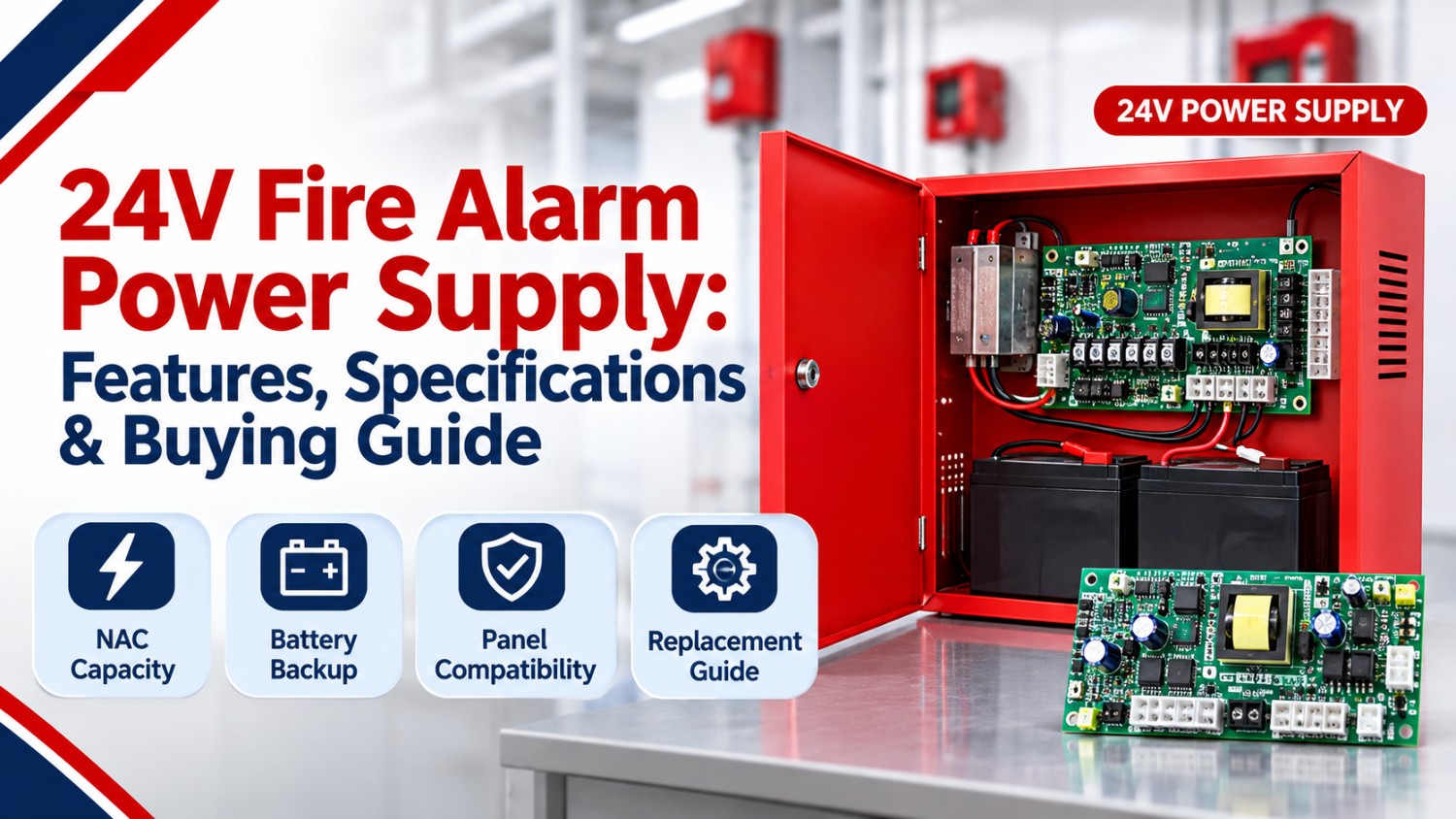
A 24V fire alarm power supply delivers the regulated low-voltage power that horns, strobes, relays and other devices need when the main control panel cannot provide enough by itself. To buy the right unit, you need to know how much current your devices draw, how the supply connects to the panel, how battery backup is calculated and whether the unit is compatible with your system. This guide covers each point, along with the specifications worth comparing and the mistakes that lead to failed inspections.
What a 24V Fire Alarm Power Supply Does
Fire alarm control panels have their own power circuits, but those circuits have limits. Every notification appliance, relay and auxiliary device draws current, and a large building can easily need more than the panel can give.
A dedicated 24V supply adds capacity without replacing the panel. It converts AC mains power into regulated low-voltage DC, charges the standby batteries and keeps notification circuits energized if the building loses utility power. Because fire alarm equipment must keep working during an outage, the pairing of supply and batteries is among the most important parts of the system.
Why 24V Is the Standard Voltage
Most commercial fire alarm systems run at a nominal 24 volts DC, which is why so many products, batteries and accessories are built around it. A 24V DC fire alarm power supply is therefore the usual starting point when you are adding capacity or replacing a failed unit.
Voltage has to be considered at the device, not just at the supply. Long wire runs reduce the voltage that reaches the last horn or strobe, and every device has a minimum operating voltage. A supply that looks adequate on paper can still cause failures if wire gauge and distance are ignored, so voltage drop calculations belong in every design.
Types of Power Supply in a 24V Fire Alarm System
A 24V supply can serve different roles, and the name on a product page does not always make the role obvious. Knowing the categories helps you select the right unit.
| Factor | NAC booster supply | Auxiliary power supply | Panel-integrated supply |
| Primary role | Adds current for notification appliance circuits | Powers relays, door holders and other devices | Powers the panel and its own circuits |
| Typical connection | Triggered by a panel output | Connected to panel power and supervision | Built into the control panel |
| Common use | Large strobe and horn installations | Devices that draw power outside the NAC | Small and mid-size buildings |
| Main buying concern | Current capacity and synchronization | Supervision and battery capacity | Whether the panel limit is exceeded |
Read the product description closely, because some supplies are designed for one role and not the other.
NAC Power Supply for Fire Alarm Systems
Notification appliance circuits, usually shortened to NACs, power the horns, strobes and speakers that alert building occupants. When too many devices share one circuit, the panel output can be overloaded.
A NAC power supply for fire alarm systems solves this by giving those devices a separate source of current, with the panel signaling the supply when an alarm occurs. QuickShipFire lists examples in its Wheelock NAC power supply category, including a PowerPath notification power supply described as an 8-amp NAC booster. When choosing one, confirm that its synchronization features match the notification appliances you use, since mismatched strobes can flash out of step.
What to Verify on a NAC Supply
- The current capacity of each output and of the unit as a whole
- How the panel triggers the supply and how its status is supervised
- Whether the supply supports synchronization for your strobes
- Battery charging capacity and the battery sizes it accepts
- The input voltage and the circuit it connects to
- The mounting size and whether the enclosure fits the available space
Auxiliary Power for Devices Beyond the Panel
Not every load is a notification appliance. Door holders, magnetic locks, relays, annunciators and some detectors may need their own power source, especially when they are installed far from the panel.
A fire alarm auxiliary power supply keeps these devices running without drawing on circuits reserved for notification. Since they still belong to a life-safety system, the supply should be supervised and battery-backed according to your design and local requirements. Start by reviewing your panel’s output limits to see whether an auxiliary unit is needed; the fire alarm panel documentation usually lists the available current.
Commercial Fire Alarm Power Supply Requirements
Commercial buildings demand more of their power equipment than small facilities do. They have more devices, longer cable runs, more frequent inspections and stricter authority review.
Choose a commercial fire alarm power supply with capacity to spare. Add up the current of every connected device in both standby and alarm conditions, then leave margin for future additions and for device aging. QuickShipFire’s catalog includes a 10-amp notification power supply described as an NAC booster for commercial systems, which gives a sense of the capacity larger installations need. Verify every specification on the manufacturer’s datasheet instead of relying on a listing summary.
Battery Backup for a 24V Fire Alarm Power Supply
Batteries keep the system and its power supply alive during a power loss, and incorrect battery sizing is a leading cause of failed acceptance tests.
NFPA 72 sets the requirements for secondary power, which commonly means the system must run on batteries for a defined standby period and then still support alarm operation for a further period. The NFPA 72 code is the primary reference, and the duration your building needs depends on the locally adopted edition and the type of system. Always confirm the requirement with your design professional or authority having jurisdiction.
How to Approach Battery Sizing
- List the standby current of every device on the supply
- List the alarm current of every device on the supply
- Multiply each by the required standby and alarm time
- Add the results and apply a margin for battery aging
- Choose batteries that meet or exceed the calculated capacity
- Confirm that the supply’s charger can recharge them within the required time
Planning a Fire Alarm Power Supply Replacement
Power supplies fail for ordinary reasons: component aging, heat, surges, weak batteries or water damage. A supply that no longer holds a charge or produces a stable output should be replaced promptly.
A fire alarm power supply replacement should begin with identifying the original model, its output rating and how it was wired. Replace it with the same model or a documented equivalent that matches the voltage, current and mounting. Afterward, test the system on both utility power and battery power, and replace aging batteries at the same time so the new supply is not paired with a weak battery.
For models not shown online, you can send a quote request with the part number and photos of the nameplate and wiring.
Where to Buy and What to Confirm
Buy a 24V supply with the same care you would give any life-safety component. Confirm that the item is new, that the model matches your requirement and that the seller’s return and warranty terms are acceptable.
QuickShipFire states that it is an independent reseller, not an authorized distributor of the brands it lists, that its products are brand new in original manufacturer packaging and that it offers a 30-day money-back policy where applicable and a one-year warranty, refund or replacement option. Read these terms before ordering so they fit your project schedule and risk tolerance.
Common Mistakes When Selecting a Power Supply
Most power-related failures come from planning errors instead of defective equipment. Avoid the following.
Mistakes to Avoid
- Ignoring voltage drop between the supply and the last device
- Sizing the supply to current demand with no margin
- Reusing old batteries with a new supply
- Assuming a NAC power supply can run any auxiliary load
- Skipping synchronization checks for strobes
- Not testing on battery power after installation
Frequently Asked Questions
What is a 24V fire alarm power supply?
A 24V DC fire alarm power supply converts mains power into regulated 24-volt DC and supplies current to fire alarm devices such as horns, strobes and relays. It usually charges standby batteries so the system keeps operating during an outage, and it adds capacity beyond what the control panel provides.
How do I choose a 24V fire alarm power supply?
Add up the current of all connected devices in standby and alarm conditions, then select a commercial fire alarm power supply with adequate capacity and margin. Confirm compatibility with your panel, the battery requirement, supervision features and mounting space. Check the manufacturer’s datasheet and local code requirements before you buy.
What is the difference between a NAC supply and a fire alarm auxiliary power supply?
A NAC supply adds current for notification appliance circuits such as horns and strobes, and the panel triggers it during an alarm. An auxiliary power supply feeds other devices, such as relays and door holders. Always confirm which role a product was designed for before ordering.
Does a 24V fire alarm power supply need batteries?
In most systems, yes. Batteries provide secondary power when utility power fails, and the capacity you need depends on the load and on the standby and alarm durations your code requires. Confirm those durations with your design professional or local authority and size the batteries accordingly.
When should a fire alarm power supply be replaced?
Replace it when it fails testing, cannot hold a stable output, shows damage or fails to charge batteries. Age and heat also contribute to failure. Follow the manufacturer’s guidance and your inspection results, and test the system on battery power after any replacement.
Is a fire alarm power supply replacement with a different model acceptable?
Sometimes, but only if the replacement matches the voltage, current, panel connections, supervision and mounting, and the system documentation and local authority accept it. When in doubt, choose the same model or consult the manufacturer or a fire protection professional.
Where can I buy a replacement 24V fire alarm power supply?
From a supplier that lists the exact model, confirms the item is new and publishes return and warranty terms. Check whether the seller is an authorized distributor and verify the datasheet before ordering. QuickShipFire lists power supplies and can help locate parts that are not shown.
Conclusion
Choosing a 24V fire alarm power supply is a matter of capacity, compatibility and battery planning. Calculate the load, confirm how the supply connects to the panel, size the batteries to meet code and test the finished installation on both utility and battery power.
If you are adding capacity or replacing a failed unit, gather your device list and existing model numbers, then browse the 24V fire alarm power supply options or send the details through the QuickShipFire quote page. The team can help confirm that the unit you select matches the system you already have.